A Complete Guide to Commercial Rooftop Solar Systems for Businesses, Offices, Schools, Hospitals & Commercial Buildings
By Solnce Energy
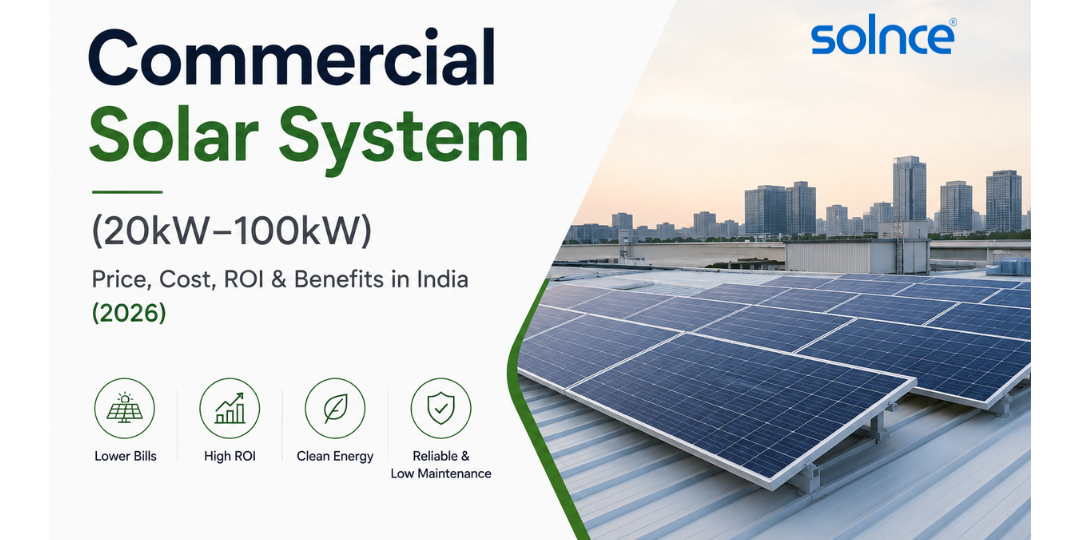
Commercial Solar System (20kW–100kW): Complete Guide
Electricity is one of the largest operational expenses for commercial establishments across India. Whether you operate an office building, shopping mall, hospital, hotel, educational institution, warehouse, or retail chain, your monthly electricity bill directly impacts your business profitability.
With commercial electricity tariffs continuing to rise every year, businesses are increasingly investing in solar energy as a long-term solution to reduce operating costs and improve sustainability.
Unlike residential rooftop systems, commercial solar systems are designed to support larger energy demands. They typically range from 20kW to 100kW, although many businesses install even larger capacities depending on their electricity consumption.
A properly designed commercial solar power system can reduce electricity expenses by 50–80%, recover its investment within 3–5 years, and continue generating clean electricity for over 25 years.
Beyond financial savings, commercial solar also helps businesses strengthen their ESG commitments, reduce carbon emissions, and project an environmentally responsible brand image—an increasingly important factor for customers, investors, and corporate partners.
This comprehensive guide explains everything you need to know about commercial solar systems in India, including pricing, system sizes, installation process, return on investment, government policies, and how to choose the right solution for your business.
Quick Answer
A commercial solar system is a rooftop or ground-mounted solar photovoltaic (PV) system designed to generate electricity for commercial establishments such as offices, hotels, hospitals, schools, warehouses, shopping complexes, and retail businesses.
Commercial systems generally range from 20kW to 100kW, depending on the building's electricity consumption and available installation area.
In India, the price of a commercial solar system varies based on capacity, panel technology, inverter brand, roof type, and project requirements. Most businesses recover their investment within 3–5 years while enjoying substantial savings on electricity bills for more than two decades.
What is a Commercial Solar System?
A commercial solar system is a solar photovoltaic (PV) installation designed specifically for businesses and commercial properties. It converts sunlight into electricity that can be used to power lighting, HVAC systems, office equipment, elevators, machinery, refrigeration units, and other electrical loads.
Unlike residential systems, commercial solar plants are engineered to handle significantly higher electricity consumption while complying with commercial electrical infrastructure and utility regulations.
These systems are commonly installed on:
• Office buildings
• Shopping malls
• Hotels
• Hospitals
• Schools and colleges
• Warehouses
• Showrooms
• Petrol pumps
• Restaurants
• Supermarkets
• IT parks
• Commercial complexes
• Cold storage facilities
Depending on the available rooftop area and electricity requirements, system capacities generally range from 20kW to 100kW, making them ideal for medium-sized commercial establishments.
Why More Businesses Are Switching to Commercial Solar
Commercial solar adoption has accelerated rapidly across India over the past few years. Rising electricity tariffs, government support for renewable energy, and improved solar technology have made rooftop solar one of the most attractive investments for businesses.
Here are the key reasons why commercial establishments are switching to solar:
1. Lower Electricity Bills
Commercial establishments often pay higher electricity tariffs than residential consumers.
Installing a commercial solar system enables businesses to generate a significant portion of their own electricity during daytime operations, reducing dependence on expensive grid power.
For many businesses, this translates into electricity bill savings of 50–80%.
2. Faster Return on Investment
Unlike many business investments that take years to deliver measurable returns, commercial solar systems generally recover their cost within 3–5 years.
Since quality solar panels continue generating electricity for over 25 years, businesses enjoy decades of low-cost energy after the payback period.
3. Protection Against Rising Electricity Prices
Electricity tariffs rarely decrease. Over time, higher tariffs can significantly increase operational expenses.
By generating electricity on-site, businesses reduce their exposure to future tariff hikes and achieve greater cost predictability.
4. Improved ESG & Sustainability
Environmental, Social, and Governance (ESG) initiatives have become an important part of modern business strategy.
Installing solar demonstrates a commitment to sustainability by:
• Reducing carbon emissions
• Supporting renewable energy
• Meeting corporate sustainability goals
• Enhancing environmental reporting
For many companies, solar also strengthens relationships with environmentally conscious customers and investors.
5. Better Brand Image
Customers increasingly prefer businesses that adopt sustainable practices.
A visible rooftop solar installation sends a strong message that the company is committed to clean energy and responsible operations.
This can positively influence customer perception, especially in sectors such as hospitality, retail, education, healthcare, and corporate services.
6. Low Maintenance Requirements
One of the biggest advantages of commercial solar systems is their low maintenance.
Routine maintenance generally includes:
• Cleaning solar panels
• Periodic inverter inspection
• Electrical safety checks
• Monitoring system performance
With proper maintenance, a commercial solar plant can operate efficiently for decades.
How Does a Commercial Solar System Work?
Although commercial solar systems are larger than residential installations, the working principle remains the same.
The process involves four key stages:
Step 1: Solar Panels Capture Sunlight
Solar photovoltaic (PV) modules absorb sunlight and convert it into Direct Current (DC) electricity.
Modern commercial projects typically use high-efficiency TOPCon or Mono PERC solar panels to maximize energy generation.
Step 2: The Inverter Converts DC into AC
Since commercial buildings operate on Alternating Current (AC), the DC electricity generated by the solar panels passes through a solar inverter.
The inverter converts DC electricity into AC electricity that can be used by the building's electrical system.
Step 3: Electricity Powers the Building
The building's electrical loads first consume the generated electricity.
These may include:
• Air conditioning systems
• Lighting
• Elevators
• Computers
• Office equipment
• Refrigeration units
• Pumps
• Kitchen equipment
• Commercial machinery
If solar generation is insufficient, additional electricity is automatically imported from the utility grid.
Step 4: Excess Electricity is Exported to the Grid
If the solar system generates more electricity than the building consumes at a given time, the surplus power may be exported to the utility grid through net metering or other applicable arrangements, subject to local regulations.
This helps maximize the financial value of the solar installation.
Types of Commercial Solar Systems
Selecting the right type of commercial solar system depends on your business requirements, budget, backup power needs, and local utility policies.
The three most common types are:
On-Grid Commercial Solar System
An on-grid system is directly connected to the utility grid and does not include battery storage.
During the day, solar electricity powers the building first, while surplus generation can be exported to the grid where applicable.
Advantages
• Lowest installation cost
• Highest efficiency
• Minimal maintenance
• Faster ROI
• Ideal for businesses with reliable grid supply
Best For
• Office buildings
• Schools
• Hospitals
• Hotels
• Shopping complexes
• Warehouses
Hybrid Commercial Solar System
A hybrid system combines solar panels, battery storage, and a grid connection.
It stores excess solar energy in batteries and automatically provides backup power during grid outages.
Advantages
• Backup during power failures
• Better energy independence
• Reduced dependence on diesel generators
• Smart energy management
Best For
Businesses that experience frequent power interruptions or require uninterrupted electricity for critical operations.
Off-Grid Commercial Solar System
Off-grid systems operate independently without a grid connection.
They rely entirely on solar generation and battery storage.
Although suitable for remote locations, they involve higher installation costs due to battery requirements.
Best For
• Remote commercial facilities
• Resorts
• Rural institutions
• Telecom sites
• Locations without reliable grid access
Comparison of Commercial Solar System Types
| Feature |
On-Grid |
Hybrid |
Off-Grid |
| Grid Connection |
Yes |
Yes |
No |
| Battery Backup |
No |
Yes |
Yes |
| Initial Cost |
Lowest |
Moderate |
Highest |
| Electricity During Power Cuts |
No |
Yes |
Yes |
| Maintenance |
Low |
Moderate |
High |
| ROI |
Fastest |
Moderate |
Longest |
| Best For |
Urban Commercial Buildings |
Businesses Requiring Backup |
Remote Locations |
Which Commercial Solar System is Right for Your Business?
For most commercial establishments in India, an on-grid commercial solar system offers the best balance of affordability, energy savings, and return on investment.
However, if uninterrupted power is critical—for example, in hospitals, data centres, hotels, or facilities with sensitive equipment—a hybrid solar system may be a better choice despite the higher upfront cost.
Businesses in remote areas without reliable utility access should consider off-grid solar systems with appropriately sized battery storage.
Commercial Solar System Sizes (20kW–100kW)
Choosing the right commercial solar system size is one of the most important decisions for any business. An undersized system may not generate enough electricity to achieve meaningful savings, while an oversized system can increase the initial investment without delivering proportional financial benefits.
The ideal system capacity depends on several factors, including:
• Monthly electricity consumption
• Connected electrical load
• Available rooftop area
• Budget
• Future business expansion
• Operating hours
• Local utility regulations
Commercial rooftop solar systems generally range between 20kW and 100kW, making them suitable for small and medium-sized commercial establishments.
The following sections explain each system size in detail.
20kW Commercial Solar System
A 20kW commercial solar system is an excellent entry-level solution for businesses with moderate daytime electricity consumption.
It is commonly installed by:
• Restaurants
• Small office buildings
• Retail stores
• Clinics
• Small hotels
• Petrol pumps
• Educational institutes
• Commercial showrooms
Typical Specifications
| Parameter |
Value |
| System Capacity |
20 kW |
| Monthly Generation |
2,200–2,600 Units |
| Annual Generation |
26,000–31,000 Units |
| Roof Area Required |
1,800–2,000 sq. ft. |
| Suitable Electricity Bill |
₹40,000–₹70,000/month |
The exact generation depends on location, solar irradiation, roof orientation, and module efficiency.
Benefits
• Significant reduction in electricity bills
• Quick payback
• Low maintenance
• Easy rooftop installation
• Ideal for businesses starting their solar journey
30kW Commercial Solar System
A 30kW solar system is suitable for businesses with higher electricity consumption that require additional energy generation without moving to a larger industrial-scale installation.
Common applications include:
• Hospitals
• Schools
• Mid-sized hotels
• Commercial offices
• Warehouses
• Corporate buildings
• Manufacturing workshops
Typical Specifications
| Parameter |
Value |
| System Capacity |
30 kW |
| Monthly Generation |
3,300–3,900 Units |
| Annual Generation |
40,000–47,000 Units |
| Roof Area Required |
2,700–3,000 sq. ft. |
| Suitable Electricity Bill |
₹60,000–₹1,00,000/month |
Businesses operating mainly during daylight hours often achieve higher self-consumption, improving the return on investment.
50kW Commercial Solar System
The 50kW commercial solar system is one of the most popular choices among medium-sized businesses because it offers an excellent balance between investment and electricity savings.
Typical users include:
• Shopping complexes
• Hotels
• Hospitals
• ducational campuses
• Warehouses
• Food processing units
• Large commercial offices
• Automobile showrooms
Typical Specifications
| Parameter |
Value |
| System Capacity |
50 kW |
| Monthly Generation |
5,500–6,500 Units |
| Annual Generation |
66,000–78,000 Units |
| Roof Area Required |
4,500–5,000 sq. ft. |
| Suitable Electricity Bill |
₹1–2 lakh/month |
A 50kW system can offset a substantial portion of daytime electricity usage, making it one of the most financially attractive commercial solar investments.
100kW Commercial Solar System
A 100kW commercial rooftop solar system is designed for businesses with high electricity consumption and large rooftop areas.
It is widely used in:
• Large hospitals
• Shopping malls
• IT parks
• Manufacturing units
• Commercial complexes
• Educational institutions
• Cold storage facilities
• Warehouses
Typical Specifications
| Parameter |
Value |
| System Capacity |
100 kW |
| Monthly Generation |
11,000–13,000 Units |
| Annual Generation |
1.3–1.5 Lakh Units |
| Roof Area Required |
9,000–10,000 sq. ft. |
| Suitable Electricity Bill |
₹2 Lakh+/month |
Although the initial investment is higher, larger systems generally offer a lower cost per kilowatt and attractive long-term financial returns.
Commercial Solar System Capacity Comparison
| Feature |
20 kW |
30 kW |
50 kW |
100 kW |
| Monthly Generation |
2,200–2,600 Units |
3,300–3,900 Units |
5,500–6,500 Units |
11,000–13,000 Units |
| Roof Area |
2,000 sq. ft. |
3,000 sq. ft. |
5,000 sq. ft. |
10,000 sq. ft. |
| Business Type |
Small Offices |
Schools |
Hotels |
Large Commercial Buildings |
| Typical ROI |
3–5 Years |
3–5 Years |
3–5 Years |
3–5 Years |
Commercial Solar System Price in India (2026)
The price of a commercial solar system depends on multiple factors, including project size, panel technology, inverter brand, roof type, mounting structure, electrical infrastructure, and installation complexity.
The following table provides indicative market pricing for complete EPC installations.
| System Capacity |
Approximate Price Range* |
| 20 kW |
₹9–12 Lakh |
| 30 kW |
₹13–17 Lakh |
| 50 kW |
₹20–28 Lakh |
| 100 kW |
₹38–55 Lakh |
*Prices are indicative and may vary depending on project specifications, location, component selection, and market conditions.
While cost is an important consideration, businesses should evaluate projects based on lifecycle value rather than initial investment alone. A high-quality system often delivers better long-term performance and lower maintenance costs.
Cost Breakdown of a Commercial Solar System
Understanding where your investment goes helps businesses make informed decisions when comparing proposals.
A commercial solar project typically includes the following components:
| Component |
Approximate Share of Project Cost |
| Solar Panels |
45–50% |
| Solar Inverters |
12–15% |
| Mounting Structure |
12–15% |
| Electrical Components |
8–10% |
| Installation & Labour |
5–8% |
| Engineering & Design |
3–5% |
| Testing & Commissioning |
2–3% |
| Monitoring System |
1–2% |
The exact distribution depends on system size and equipment selection.
Factors Affecting Commercial Solar System Cost
Every commercial project is unique. Several technical and commercial factors influence the final project cost.
1. Solar Panel Technology
Modern projects generally use:
• TOPCon Modules
• Mono PERC Modules
• N-Type Modules
Higher-efficiency modules typically cost more but produce greater energy over the system's lifetime.
2. Inverter Brand
The inverter is one of the most critical components of a commercial solar system.
Premium inverter brands generally offer:
• Higher efficiency
• Better monitoring
• Longer warranty
• Improved reliability
3. Roof Type
Installation costs vary depending on whether the project is installed on:
• RCC roofs
• Metal sheet roofs
• Elevated structures
• Carports
Complex roof geometries may require additional engineering and customized mounting structures.
4. Mounting Structure Design
Factors influencing mounting costs include:
• Wind load requirements
• Building height
• Corrosion protection
• Material selection (HDG Steel or Aluminium)
• Tilt angle
A properly engineered mounting structure ensures long-term safety and durability.
5. Electrical Infrastructure
The existing electrical system also affects project costs.
Engineers evaluate:
• LT panels
• Transformer capacity
• Cable routing
• Metering arrangement
• Grid connection point
Projects requiring electrical upgrades may involve additional investment.
6. Installation Complexity
Building height, restricted access, rooftop obstructions, and safety requirements can influence labour costs and project duration.
Roof Area Required for Commercial Solar
One of the most common questions businesses ask is, "How much roof space do I need?"
As a general guideline:
| System Size |
Approximate Shadow-Free Roof Area |
| 20 kW |
1,800–2,000 sq. ft. |
| 30 kW |
2,700–3,000 sq. ft. |
| System Size |
Approximate Shadow-Free Roof Area |
| 50 kW |
4,500–5,000 sq. ft. |
| 100 kW |
9,000–10,000 sq. ft. |
These values are approximate and can vary based on module wattage, tilt angle, walkway requirements, and site-specific design considerations.
Typical Installation Timeline
Commercial solar projects generally follow this timeline:
| Activity |
Duration |
| Site Survey & Energy Audit |
3–7 Days |
| Engineering & Design |
1–2 Weeks |
| Approvals |
2–4 Weeks |
| Procurement |
1–3 Weeks |
| Installation |
2–4 Weeks |
| Testing & Commissioning |
2–5 Days |
Most 20kW–100kW commercial solar systems can be completed within 4–8 weeks, depending on project complexity and approval timelines.
Commercial Solar Installation Process
Installing a commercial solar system involves much more than placing solar panels on a rooftop. A successful project requires careful planning, engineering, regulatory approvals, quality equipment, professional installation, and thorough testing before commissioning.
An experienced Solar EPC (Engineering, Procurement & Construction) company manages every stage of the project to ensure maximum performance, safety, and long-term reliability.
The commercial solar installation process generally includes the following steps:
1. Energy Audit
The first step is understanding the business's electricity consumption. Engineers analyze the last 12 months of electricity bills, connected load, maximum demand, operating hours, and future expansion plans to determine the ideal system capacity.
2. Site Survey
A detailed survey evaluates the available rooftop space, structural condition, orientation, shading, cable routes, electrical panels, and installation feasibility.
3. System Design
Based on the survey, engineers prepare:
• Solar panel layout
• Inverter sizing
• String design
• Single Line Diagram (SLD)
• Cable sizing
• Earthing design
• Mounting structure drawings
4. Engineering & Approvals
The EPC team prepares all required engineering documents and assists with DISCOM approvals, net metering applications, and other statutory requirements where applicable.
5. Procurement
Only high-quality components should be used, including:
• Tier-1 solar panels
• Premium inverters
• HDG mounting structures
• DC & AC protection equipment
• Monitoring systems
6. Installation
The installation team completes:
• Mounting structure installation
• Solar panel installation
• DC wiring
• AC integration
• Earthing
• Lightning protection
• Monitoring system installation
7. Testing & Commissioning
Before handover, the plant undergoes comprehensive testing to verify electrical safety, system performance, inverter configuration, and grid synchronization.
Once testing is complete, the system begins generating electricity.
Commercial Solar System ROI & Payback
For most businesses, the biggest question isn't "How much does a commercial solar system cost?"—it's "How quickly will it pay for itself?"
The answer depends on several factors, including electricity tariff, system size, operating hours, financing model, and self-consumption of solar energy.
In most commercial applications, rooftop solar delivers an attractive return on investment because businesses consume a large share of their electricity during daylight hours, when solar generation is highest.
Typical Financial Performance
After recovering the initial investment, businesses continue to benefit from significantly reduced electricity costs for many years, making solar one of the most rewarding long-term infrastructure investments.
Net Metering for Commercial Solar Systems
Net metering is an important mechanism that improves the financial performance of commercial solar systems.
When the solar plant generates more electricity than the building consumes, the excess energy can be exported to the utility grid, subject to applicable state regulations.
The exported electricity is credited against future electricity consumption, reducing the overall electricity bill.
Net metering policies vary across Indian states and are periodically updated by DISCOMs. Businesses should consult their EPC partner and local utility before finalizing a project.
Key Benefits of a Commercial Solar System
Significant Reduction in Electricity Bills
Commercial solar systems can reduce daytime electricity costs by up to 80%, depending on system sizing and energy consumption patterns.
Long-Term Cost Stability
Unlike grid electricity tariffs, which typically increase over time, solar provides a predictable cost of electricity throughout the system's operational life.
Improved Sustainability
Commercial solar helps businesses reduce carbon emissions and align with ESG goals, enhancing their environmental credentials.
Low Maintenance
Routine cleaning, inspections, and monitoring are generally sufficient to keep a well-designed commercial solar system operating efficiently.
Better Business Image
Customers, investors, and corporate clients increasingly value businesses that demonstrate a commitment to sustainability. Solar installations visibly reinforce this commitment.
Increased Property Value
Buildings equipped with solar energy systems often become more attractive to buyers and tenants because of their lower operating costs and sustainability features.
Common Mistakes Businesses Should Avoid
Installing a commercial solar system is a significant investment, and avoiding common mistakes can improve long-term performance and financial returns.
Choosing the Cheapest EPC Contractor
The lowest quotation may not include quality components, proper engineering, or reliable after-sales support. Evaluating long-term value is more important than selecting the lowest upfront price.
Ignoring Roof Condition
A structural assessment should always be completed before installation to ensure the roof can safely support the solar system.
Using Low-Quality Components
Poor-quality panels, inverters, or mounting structures can reduce energy generation and increase maintenance costs over time.
Incorrect System Sizing
The solar system should be designed based on the business's actual electricity consumption, operating hours, and future expansion plans.
Neglecting Maintenance
Regular cleaning, inspections, and monitoring are essential for maintaining high energy production throughout the plant's lifetime.
Why Choose Solnce Energy?
At Solnce Energy, we specialize in delivering customized commercial rooftop solar solutions that help businesses reduce electricity costs while supporting their sustainability goals.
Our end-to-end EPC services include:
• Energy Audit & Consumption Analysis
• Site Survey & Feasibility Study
• System Design & Engineering
• Financial Analysis & ROI Estimation
• DISCOM & Net Metering Support
• Procurement of Premium Components
• Professional Installation
• Testing & Commissioning
• Remote Monitoring
• Preventive Maintenance & O&M Services
Whether you are planning a 20kW rooftop solar system for a commercial office or a 100kW solar plant for a large business facility, our experienced team ensures every project is engineered for maximum efficiency, safety, and long-term performance.
Ready to Reduce Your Commercial Electricity Bills?
If your business is looking to lower electricity expenses, improve sustainability, and achieve long-term energy savings, a commercial solar system is one of the smartest investments you can make.
At Solnce Energy, we help businesses identify the right system size, estimate savings, and manage the entire project—from design and approvals to installation and long-term support.
Contact Solnce Energy today for a free commercial solar consultation and customized proposal.
Frequently Asked Questions (FAQs)
1. What is a commercial solar system?
A commercial solar system is a solar photovoltaic (PV) installation designed to generate electricity for businesses such as offices, hotels, hospitals, schools, warehouses, and commercial buildings.
2. What size commercial solar system do I need?
The ideal system size depends on your monthly electricity consumption, available rooftop area, and business operations. Most commercial installations range from 20kW to 100kW.
3. How much does a commercial solar system cost in India?
Commercial solar system prices vary by capacity and project specifications. Indicatively, prices range from ₹9 lakh for a 20kW system to ₹55 lakh for a 100kW system.
4. What is the payback period?
Most commercial solar systems recover their investment within 3–5 years, depending on electricity tariffs and system utilization.
5. How much roof area is required?
Approximately 90–100 sq. ft. of shadow-free roof area per kW is required, although the exact requirement depends on module size and layout.
6. Can commercial solar systems work during power cuts?
Standard on-grid systems shut down during grid outages for safety. Businesses requiring backup power should consider hybrid systems with battery storage.
7. Do commercial solar systems require batteries?
Most commercial systems are on-grid and operate without batteries. Batteries are only required for backup or off-grid applications.
8. How long do commercial solar panels last?
Quality solar panels typically have a 25-year performance warranty and often continue generating electricity beyond that period.
9. What maintenance is required?
Routine panel cleaning, inverter inspections, electrical checks, and performance monitoring are generally sufficient to keep the system operating efficiently.
10. Is commercial solar suitable for rented buildings?
Yes, provided the building owner approves the installation and the lease agreement allows long-term infrastructure modifications.
11. What type of roof is best for commercial solar?
Both RCC and metal sheet roofs are suitable, provided they pass structural assessment and are designed with appropriate mounting systems.
12. Can commercial solar increase property value?
Yes. Solar-equipped commercial buildings often become more attractive to buyers and tenants because of reduced operating costs and sustainability benefits.
Conclusion
Commercial solar has become one of the most effective investments for businesses seeking to reduce electricity costs, improve operational efficiency, and strengthen their sustainability commitments.
Whether you're considering a 20kW system for a small office or a 100kW installation for a commercial complex, choosing the right system size, quality components, and an experienced EPC partner is essential for maximizing long-term returns.
With rising electricity tariffs and growing demand for clean energy, investing in commercial solar today can provide decades of predictable savings while helping your business build a more sustainable future.