QUICK ANSWER
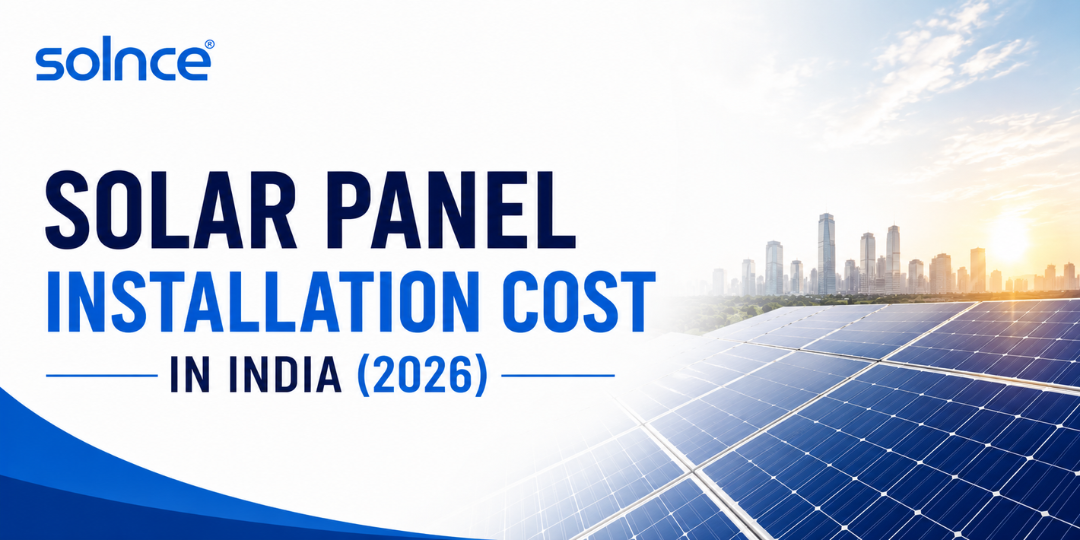
In 2026, a fully installed on-grid rooftop solar system in India costs approximately ₹55,000–₹85,000 per kW.
A 3-kW home system costs around ₹1.65–₹2.25 lakh before subsidy and ₹87,000–₹1.47 lakh after the PM Surya Ghar subsidy.
Commercial systems typically cost ₹45,000–₹50,000 per kW, with an average payback period of 3.5–5 years.
Rooftop solar in India has crossed a tipping point. With the PM Surya Ghar Muft Bijli Yojana paying central subsidies up to ₹78,000, several states adding their own top-ups, and DISCOM tariffs continuing to climb every year, the math for installing solar has rarely looked better. But solar quotes still vary wildly — from honest, itemised pricing to lowball numbers that quietly leave out critical components.
This guide breaks down the real all-in cost of solar panel installation in India for 2026: per watt, per kW, by system size, before and after subsidy, by city, with loan EMI options, payback period and the most common mistakes that inflate quotes. Use it to judge any installer's price with confidence — and to know exactly what you should be paying.
1. Solar Cost Per Watt & Per kW in India (2026)
The single most useful number when comparing two solar quotes is the complete installed cost per watt — not the panel-only price, which always looks deceptively low. Some installers quote only the module price and add inverter, structure, wiring and installation later as ‘extras. A fair quote bundles it all.
Here is what the 2026 market actually looks like across India:
| Cost Basis |
Residential (On-Grid) |
What It Includes |
|
Solar Module Only (Per Watt)
|
₹22 – ₹35
|
Panels only
N-Type Topcon: ₹22–30/W
Bifacial: ₹24–35/W
|
|
Complete System (Per Watt Installed)
|
₹55 – ₹85
|
Panels + Inverter + Mounting Structure +
Cabling + Labour + GST
|
|
Complete System (Per kW Installed)
|
₹55,000 – ₹85,000
|
Full installed system cost expressed per kilowatt
|
|
Commercial / Industrial (Per kW)
|
₹45,000 – ₹50,000
|
Larger system sizes benefit from economies of scale
|
The wide ₹55,000–₹85,000 band comes down to four things: brand tier (Tata/Waaree/Adani sit at the top end; lesser-known DCR brands sit lower), inverter quality (a string inverter from a Tier-1 brand costs almost double a no-name one), roof type (sloped tiled roofs and elevated mounting structures are more expensive than flat RCC roofs), and city/labour rates (metros are 10–15% pricier than Tier-2 cities).
PRO TIP
When you receive a quote, divide the total price by the system size in watts to get the
per-watt figure. Anything below
₹50/W for an on-grid residential system either uses
sub-standard equipment, omits critical components, or excludes GST. Anything above
₹90/W usually has a margin you can negotiate down.
2. Solar Panel Price by System Size (1 kW to 10 kW)
System size is the single biggest driver of total cost. The table below shows typical 2026 on-grid price bands, the applicable PM Surya Ghar central subsidy, and the effective cost you actually pay. Roof area is the shade-free space your panels will need.
| System Size |
Before-Subsidy Cost |
PM Surya Ghar Subsidy |
Effective Cost |
Roof Area |
Typical Monthly Generation |
|
1 kW
|
₹70,000 – ₹1.1 lakh |
₹30,000 |
₹40,000 – ₹80,000 |
80–100 sq ft |
120–140 units |
|
2 kW
|
₹1.1 – 1.5 lakh |
₹60,000 |
₹50,000 – ₹90,000 |
160–200 sq ft |
240–280 units |
|
3 kW
Most Popular
|
₹1.65 – 2.25 lakh |
₹78,000 (Max) |
₹87,000 – ₹1.47 lakh |
250–300 sq ft |
360–400 units |
|
5 kW
|
₹2.8 – 3.8 lakh |
₹78,000 (Capped) |
₹2.02 – 3.02 lakh |
400–450 sq ft |
600–680 units |
|
10 kW
|
₹4.5 – 6.5 lakh |
₹78,000 (Capped) |
₹3.72 – 5.72 lakh |
≈ 800 sq ft |
1,200–1,400 units |
Important: The central subsidy is capped at ₹78,000 for any system of 3 kW or larger in general states — installing 5 kW or 10 kW does not increase your central subsidy. The only exceptions are special-category states (North-East and hill states), which receive a higher central subsidy of up to ₹1,17,000. Always confirm the current figure for your state on pmsuryaghar.gov.in.
Why 3 kW is the sweet spot: It qualifies for the maximum ₹78,000 central subsidy, comfortably covers a typical ₹2,500–₹4,000 monthly electricity bill, and pays back in roughly 3.5–4 years. Over 80% of residential PM Surya Ghar installations in India are 3 kW for exactly this reason.
3. PM Surya Ghar Subsidy — How the Maths Actually Works
The PM Surya Ghar Muft Bijli Yojana, launched in February 2024, is the largest residential solar scheme India has ever run, with a total budget of ₹75,021 crore and a target of 1 crore homes. The central subsidy is paid directly into your bank account via DBT (Direct Benefit Transfer), usually 30–45 days after final DISCOM commissioning.
The subsidy slabs are simple once you see them in a table:
| Capacity Slab |
Subsidy Rate |
Cumulative Central Subsidy |
|
First 1 kW
|
₹30,000 per kW
|
₹30,000
|
|
Second kW (Total 2 kW)
|
₹30,000 per kW
|
₹60,000
|
|
Third kW (Total 3 kW)
|
₹18,000 per kW
|
₹78,000
Maximum
|
|
4th kW and Above (Up to 10 kW)
|
No Additional Central Subsidy
|
₹78,000 (Capped)
|
Three conditions you must meet to receive the subsidy:
• You must be an Indian citizen with a valid electricity connection from a DISCOM.
• The installer must be MNRE-empanelled, and the panels must be ALMM-listed (Approved List of Models and Manufacturers).
• The applicant must not have availed of a solar subsidy previously under another government scheme.
The process is filed online at pmsuryaghar.gov.in: register with your mobile and consumer number, apply for rooftop solar, get feasibility approval from your DISCOM, choose an empanelled vendor, install the system, get the final DISCOM inspection, and the subsidy lands in your bank account by DBT within 30 working days.
4. State Top-Up Subsidies — Often Overlooked
Several states layer their own subsidy on top of the central ₹78,000, which can dramatically reduce the effective cost of a 3 kW system. These top-ups change periodically, so verify with your state's renewable energy agency before quoting a customer, but here are the ones currently active in 2026:
| State |
State Top-Up (2 kW or 3 kW) |
Combined Maximum Subsidy (3 kW) |
|
Uttar Pradesh
|
₹15,000/kW (Cap ₹30,000)
|
₹1,08,000
|
Special-Category States
(NE & Hill States)
|
Additional Central Support
|
Up to ₹1,17,000
|
|
Bihar, Rajasthan
|
Top-Ups Announced;
Verify Locally
|
Above ₹78,000
|
|
Other States
|
Mostly Central Subsidy Only
|
₹78,000
|
If you're in UP, for example, a 3 kW system costing ₹1.85 lakh before subsidy can effectively cost as little as ₹77,000 after the combined central + state subsidy of ₹1,08,000. That is the cheapest entry point into residential solar India has ever offered.
5. What ₹1.65 Lakh Actually Buys You — Component Breakdown
A trustworthy installer will give you an itemised quote showing exactly what every rupee buys. If a quote is a single lump sum with no breakup, treat it as a red flag — it's almost always hiding either a margin or a corner cut.
Here is roughly how the cost of a 3 kW residential system breaks down:
| Component |
Share of Cost |
Why It Matters |
|
Solar Panels (Modules)
|
≈ 50–55%
|
Largest cost component. ALMM-listed N-Type TOPCon or Bifacial modules are mandatory for subsidy eligibility.
|
|
Inverter (On-Grid String Inverter)
|
≈ 15–18%
|
Determines system efficiency, performance and warranty. Tier-1 brands are recommended.
|
|
Mounting Structure (GI / Aluminium)
|
≈ 8–10%
|
Cyclone and wind-load rating, corrosion resistance and 25+ year durability are critical.
|
|
Cabling, DCDB/ACDB, Earthing & SPD
|
≈ 6–8%
|
The area where cheap quotations most often cut corners. Essential for safety and protection.
|
|
Net-Metering & Bi-Directional Meter
|
≈ 2–3%
|
State-specific DISCOM charges apply and vary by location.
|
|
Installation Labour, Transport & Scaffolding
|
≈ 8–10%
|
Roof type, building height and site complexity significantly impact costs.
|
|
GST (Concessional Rate on Solar)
|
Included Above
|
Solar installations in India benefit from concessional GST rates.
|
The two places where unethical installers cut quietly are balance-of-system components (cheap cables, undersized DCDB, missing surge protection) and structure thickness. Both are invisible on day one and catastrophic by year five. Insist on a written component list with brand names and warranty terms.
WHY SOLNCE INSTALLS ONLY N-TYPE TOPCON AND BIFACIAL PANELS
Both are 2024-onward generation technologies. N-Type TOPCon delivers 22%+ conversion efficiency, a 30-year linear power warranty, and roughly half the annual degradation rate of older modules. Bifacial panels generate power from both sides — capturing 5–15% extra yield from reflected ground/roof light — making them especially valuable on white or light-colored rooftops. The ~5–10% premium over older module technology pays back several times over 25-year energy yield.
6. On-Grid vs Hybrid vs Off-Grid — How Type Changes Cost
The kind of solar system you install changes the price more than people expect. Most residential buyers don't need anything beyond on-grid.
| Type |
Cost per kW |
Subsidy Eligible? |
Best For |
On-Grid
(Grid-Tied, No Battery)
|
₹55,000 – ₹85,000
|
Yes
|
Most urban and semi-urban homes;
reliable grid supply
|
Hybrid
(Battery + Grid)
|
₹90,000 – ₹1,40,000
|
Partial Eligibility
|
Areas with moderate power cuts;
backup essential
|
Off-Grid
(Battery Only, No Grid)
|
₹1,10,000 – ₹1,80,000
|
No
|
Remote sites without grid access;
farmhouses and isolated properties
|
The premium on hybrid and off-grid is almost entirely the battery — lithium-ion battery banks remain the most expensive component in a solar system, and their lifespan (8–12 years) is shorter than the panels (25 years). Unless you face daily multi-hour power cuts, on-grid is the rational financial choice.
7. City & State-Wise Cost Variation
Per-kW pricing varies by city due to labour rates, transport, roof types and local DISCOM processes. Metros sit at the higher end of the ₹55,000–₹85,000/kW band; Tier-2 and Tier-3 cities often come in lower because of cheaper labour and lower establishment costs.
Southern states with high DISCOM tariffs — TANGEDCO in Tamil Nadu, BESCOM in Karnataka, APSPDCL in Andhra Pradesh — show the fastest payback because the bill you offset is larger. A ₹6/unit tariff state and a ₹9/unit tariff state can have identical installation costs but very different payback periods, because the savings side of the equation is larger in the higher-tariff state.
As a rough guide for residential 3 kW after subsidy: Mumbai and Bengaluru ₹1.2–1.5 lakh; Delhi NCR ₹1.0–1.3 lakh; Pune, Hyderabad and Chennai ₹1.0–1.4 lakh; Tier-2 cities in UP, MP, Gujarat and Rajasthan ₹85,000–1.2 lakh (lower in UP after state top-up).
8. Bank Loans & EMI Options for Solar in 2026
The PM Surya Ghar scheme mandates that public sector banks offer collateral-free solar loans to residential applicants. As of 2026, the most competitive options are:
| Bank |
Interest Rate (p.a.) |
Loan Limit |
Tenure |
Collateral |
|
SBI Surya Ghar Loan
|
≈ 7.15%
(RLLR-Linked)
|
₹2 Lakh (≤3 kW)
₹6 Lakh (3–10 kW)
|
Up to 10 Years
|
None up to ₹2 Lakh
|
|
Canara Bank CRTS
|
≈ 6.50% – 7.15%
|
Up to ₹6 Lakh
|
Up to 10 Years
|
None for Smaller Systems
|
|
Union Bank of India
|
EBLR-Linked
(≈ 7%+)
|
Up to ₹6 Lakh
|
Up to 10 Years
|
None (Small Systems)
|
|
PNB Surya Shakti
|
≈ 7.25%+
|
Up to ₹6 Lakh
|
Up to 10 Years
|
None (Small Systems)
|
For a 3-kW system, after the ₹78,000 subsidy, the post-subsidy loan is roughly ₹87,000. At 7.15% over 10 years, that works out to an EMI of approximately ₹900–₹1,000 per month
— almost always lower than the electricity bill the system replaces. In effect, the system pays its own EMI.
BEST STRATEGY
Best strategy: Finance the full pre-subsidy cost, then when the
₹78,000 subsidy lands in your account
(30–45 days after commissioning), use it to pre-pay the loan principal.
PM Surya Ghar loans carry no prepayment penalty, so this drastically reduces
your interest burden.
9. Payback Period & 25-Year Savings
The payback period is when your cumulative electricity savings equal what you paid for the system. With the PM Surya Ghar subsidy applied, most residential rooftop systems in India pay back in 3.5 to 5 years. After payback, the system delivers effectively free electricity for the remaining 20+ years of its 25-year warranted life.
The maths for a typical 3 kW system in a ₹8/unit tariff city:
| Metric |
3 kW System (Typical) |
|
Installed Cost (Before Subsidy)
|
₹1.85 Lakh
|
|
PM Surya Ghar Subsidy
|
₹78,000
|
|
Effective Cost
|
₹1.07 Lakh
|
|
Annual Generation
|
≈ 4,500–5,000 Units
|
|
Annual Savings @ ₹8/Unit
|
≈ ₹36,000–₹40,000
|
|
Simple Payback Period
|
≈ 3 Years
|
|
Lifetime Savings (25 Years, Conservative)
|
₹7–₹9 Lakh
|
With tariffs rising at 5–8% annually in most states, the actual lifetime savings tend to be higher than the conservative figure above. There is also the unmeasured benefit of tariff insulation — you stop being exposed to electricity price inflation for the system's life.
10. Commercial Solar & the Zero-Investment PPA Option
For businesses, the installed cost per kW is lower (≈ ₹45,000–₹50,000) due to scale. But the bigger lever is the financing model. Under a Power Purchase Agreement (PPA), a developer like Solnce installs and owns the rooftop solar plant at zero upfront cost to the business. You simply buy the solar electricity generated at a fixed, contractually-locked tariff (typically ₹4.00–₹5.00 per unit) — well below current commercial DISCOM tariffs of ₹7–₹11/unit.
This converts a capex decision into immediate, predictable operating savings and removes the technical risk of ownership (maintenance, performance, breakdowns) from the business entirely. For factories, warehouses, IT parks, hospitals and educational institutions, PPA has become the dominant solar adoption model in 2026.
11. Five Mistakes That Quietly Inflate Solar Cost
1. Chasing only the lowest per-watt number. A ₹48/W quote will usually cost more by year five through replacements and lost generation than a ₹65/W quote with Tier-1 components.
2. Accepting lump-sum quotes. Always demand a line-item breakup of panels (brand + model + watts), inverter (brand + model), structure, cables, DCDB/ACDB, labour and GST.
3. Skipping ALMM verification. Non-ALMM panels disqualify you from the PM Surya Ghar subsidy. Always ask for the panel's ALMM listing reference before signing.
4. Ignoring the inverter warranty. Panels carry 25-year performance warranties; on-grid inverters typically come with 5–10 years. A cheap inverter failure at year 6 wipes out years of savings.
5. Going hybrid when on-grid would do. If you have a stable grid, the battery premium of ₹40,000–₹70,000 rarely pays back. Re-examine whether you actually need the backup.
12. Real Scenario — A Home With a ₹3,500 Monthly Bill
The household
A 3 BHK home in Pune, monthly bill ₹3,500 (≈ 350 units), flat RCC roof with 300 sq ft free area, stable grid, looking at solar for the first time.
The right system
3 kW on-grid N-Type TOPCon, Tier-1 panels, 3 kW string inverter, GI mounting structure, net metering.
The numbers
Installed cost: ₹1.85 lakh. PM Surya Ghar subsidy: ₹78,000. Effective cost: ₹1.07 lakh. Financed via SBI Surya Ghar loan @ 7.15% over 10 years, EMI ≈ ₹1,250/month on the gross loan — dropping to ≈ ₹900/month after subsidy pre-payment.
The outcome
Generation ≈ 380 units/month. Bill drops from ₹3,500 to ≈ ₹100–₹400/month (fixed charges + occasional overuse). Net monthly saving after EMI: ≈ ₹2,200. Payback: ≈ 3 years. 25-year savings: ≈ ₹8–9 lakh.
Frequently Asked Questions (15)
1. What is the cost of solar panel installation in India in 2026?
A fully installed on-grid rooftop solar system in India costs approximately ₹55,000 to ₹85,000 per kW in 2026. A typical 3 kW home system costs about ₹1.65–2.25 lakh before subsidy, dropping to roughly ₹87,000–₹1.47 lakh after the PM Surya Ghar central subsidy of up to ₹78,000. Commercial installations cost less per kW (about ₹45,000–₹50,000) due to scale.
2. How much subsidy do I get under PM Surya Ghar Yojana?
The central government provides ₹30,000 per kW for the first 2 kW and ₹18,000 for the 3rd kW, for a maximum central subsidy of ₹78,000 on a 3 kW or larger residential system. Special-category states like the North-East and hill states receive up to ₹1,17,000. Several states (UP, Bihar, Rajasthan and others) add their own top-ups, which can take the combined subsidy past ₹1 lakh.
3. What is the cost of a 3 kW solar system after subsidy?
A 3 kW on-grid system costs approximately ₹1.65–2.25 lakh before subsidy. After the ₹78,000 PM Surya Ghar subsidy, the effective cost is about ₹87,000 to ₹1.47 lakh, depending on city, panel brand, inverter choice and installer. In states offering top-ups (like UP), the effective cost can fall below ₹90,000.
4. How much does a 5 kW solar system cost in India?
A 5 kW on-grid system costs about ₹2.8–3.8 lakh before subsidy. The PM Surya Ghar central subsidy is capped at ₹78,000 for any system of 3 kW or larger in general states — installing a 5 kW system does not increase your central subsidy. After the ₹78,000 subsidy, the effective cost is roughly ₹2.02–3.02 lakh. State top-ups (where available) can reduce this further.
5. What is the per-watt price of solar panels in India in 2026?
Solar modules alone cost roughly ₹22 to ₹35 per watt in 2026, with N-Type TOPCon panels in the ₹22–30 per watt range and Bifacial panels in the ₹24–35 per watt range. A completely installed on-grid system, including inverter, mounting structure, wiring, installation and GST, costs about ₹55–85 per watt for residential use.
6. Which solar system size is best for an average Indian home?
A 3 kW system suits most 2–3 BHK homes with a monthly electricity bill of ₹2,500–₹4,000. It generates roughly 360–400 units per month and qualifies for the maximum ₹78,000 PM Surya Ghar subsidy, making it the most cost-efficient size for residential buyers.
7. What is the payback period for rooftop solar in India?
With the PM Surya Ghar subsidy applied, most residential rooftop systems pay back in 3.5 to 5 years. After payback, the system delivers effectively free electricity for the remaining 20+ years of its 25-year service life, leading to lifetime savings of ₹7–9 lakh on a typical 3 kW home system.
8. Does the solar installation cost include net metering and DISCOM approvals?
A transparent itemised quote should include panels, inverter, mounting structure, cabling, installation labour and GST. Net-metering application and DISCOM liaison are usually handled by an MNRE-empanelled installer at no extra charge, but small DISCOM inspection or bi-directional meter charges may apply separately depending on your state.
9. Is rooftop solar cheaper for commercial buildings than homes?
Yes. Commercial and industrial installations typically cost about ₹45,000–₹50,000 per kW due to larger system sizes and economies of scale, versus ₹55,000–₹85,000 per kW for residential. Businesses can also avoid all upfront costs through a Power Purchase Agreement (PPA), where a developer installs and owns the system, and the business simply pays for the solar power generated at a tariff below the grid rate.
10. What factors change the final solar installation cost?
Final cost depends on system size, panel technology (N-Type TOPCon or Bifacial), inverter type (on-grid, hybrid or off-grid), roof type and height, city and labour rates, brand and warranty, and central plus state subsidy eligibility. Battery storage, elevated structures and remote locations add significantly to cost.
11. Are solar prices expected to rise in 2026?
Solar prices have largely stabilised in 2026, but tighter ALMM (Approved List of Models and Manufacturers) enforcement expected later in the year could push complete system costs up by an estimated 10–15%. Installing while the PM Surya Ghar subsidy window is open generally improves the economics significantly.
12. Can I pay for solar in EMIs?
Yes. SBI, Canara Bank, PNB and Bank of Baroda offer PM Surya Ghar collateral-free solar loans at concessional rates starting around 6.50%–7.25% per annum, with tenures up to
10 years. On a 3 kW system, the post-subsidy EMI is typically ₹900–₹1,800 per month — often lower than the electricity bill it replaces.
13. What is the difference between on-grid, hybrid and off-grid solar system costs?
On-grid (grid-tied, no battery) systems are the cheapest at ₹55,000–₹85,000 per kW and qualify for a subsidy. Hybrid systems with battery backup cost roughly 50–80% more due to lithium-ion battery costs. Off-grid systems with full battery banks cost about double the on-grid price and are only recommended for areas with unreliable or no grid connectivity.
14. How long does it take to install a rooftop solar system?
The physical installation of a residential 3–5 kW rooftop solar system takes only 2–3 days. However, the end-to-end process from application to commissioning — including DISCOM feasibility, net metering, inspection and subsidy disbursement — usually takes 30 to 90 days, depending on your state and DISCOM workload.
15. What documents are required to apply for the PM Surya Ghar subsidy?
You need your latest electricity bill (showing the consumer/connection number), Aadhaar card, an Aadhaar-seeded bank passbook (for direct subsidy transfer), proof of property ownership or NOC from the owner, and a passport-size photograph. Applications are filed online at pmsuryaghar.gov.in.
Ready to Lock in 2026 Pricing & Subsidy?
Solnce Energy handles design, ALMM-listed equipment, subsidy filing and lifetime AI/ML performance monitoring — for homes, commercial rooftops and PPA projects.
Talk to a Solar Expert →