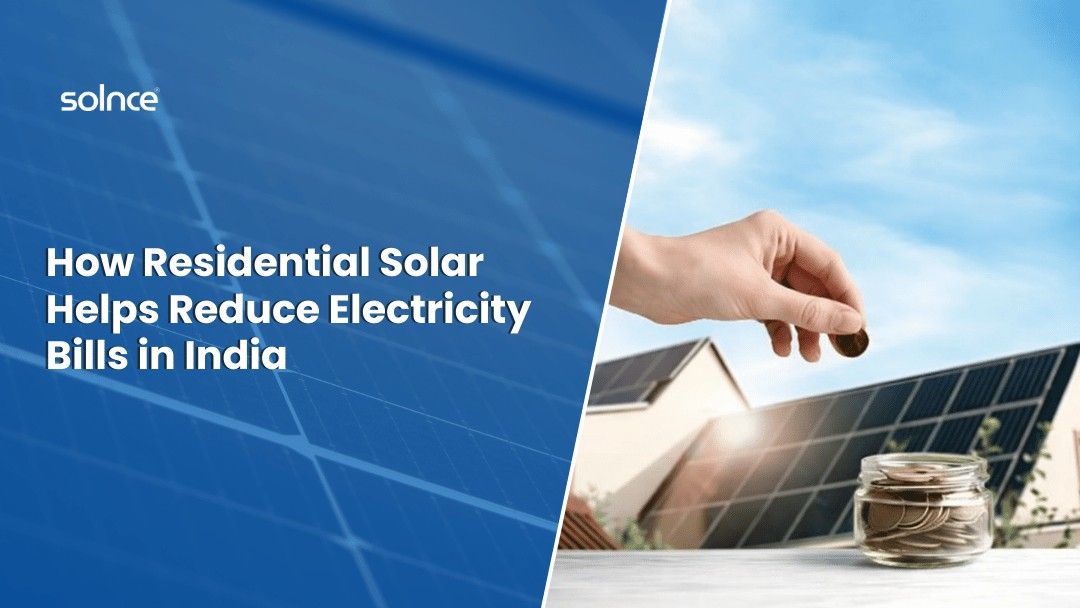
Homeowners mostly attempt to make ends meet by turning off lights, reducing the amount of AC, or being more conscientious with appliances. However, in spite of these attempts, the bill does not often go down in anything meaningful.
It is here that residential solar is enabling Indian households to regain control although not necessarily on the utility bills, but on the manner in which they use power in general.
Why Electricity bills in India are ever rising.
In India, they do not have fixed prices on electricity. They are affected by various variables that cannot be controlled by the home owners.
The majority of state electricity boards have a slab-based pricing scheme; in this case, the price per unit goes up in line with increase in use. The usage can be slightly raised making a household soar into the next slab leading to a significantly higher bill.
The important role is also played by the seasons demands as fridge, AC and coolers are most used during summers. This contributes to increased use of electricity at the time when tariffs are already high.
Top of this, electricity boards revise tariffs and so even after consuming the same amount, your bill will keep on growing as time goes by. This provides a circle of escalating prices without a definite answer to the homeowners.
What Residential Solar Is and How It works.
Residential solar refers to setting up solar panels on your roof to produce electricity with the help of the sunlight. These are panels which take sunlight and transform it into direct power which can be utilized directly by your house.
Your home is powered by first using solar energy during the day when sunlight is available. In case your power system generates more electricity than you need, then you can pass the electricity back to the grid via net metering. During the night or low sunlight, your house goes on getting the electricity relation as usual through the grid.
The whole procedure is automatic. You will not have to adjust your everyday life and jeopardize your comfort.
How Residential Solar Savings You Up to Ton Electricity bill.
The short-term good of solar in the residential neighborhood is a loss of a grid reliance. As your own home has already a supply of electricity, the quantity of units you will use in the electricity board is really decreased.
The decreased number of units that are consumed will translate to decreased bills.
The savings is also enhanced through Net metering. The additional electricity that your system exports to the power grid is traded in units which is put against your bill. These credits have the effect of leveling out increased consumption months with time, particularly in summer.
The electricity bill of many solar-powered households reduces by 70-90 percent. In other instances, a bill reduces to insignificant levels paying fixed charges only.
In case the bills are the highest, Solar Does Best.
Interestingly the months which the electricity bills hurt most are the months where solar performance is the most effective.
Summers are a period of longer days with intense sunlight that can be utilized by solar panels to offer all the power. This implies that as the amount of electricity that people use up because of cooling demands goes up, the amount of solar that is produced goes up as well- compensating the bill.
This inherent correspondence of solar toward residential is most conducive to the Indian weather.
Should Solar Residential be atrav cost wise?
Although residential solar does demand the initial investment, the same is best considered as a long run financial resource, as opposed to being an expense.
A residential solar system on average breaks even after 4-6 years. The solar panels will have a lifespan of more than 25 years hence the homeowners are happy to pay minimal electricity bills after payback period.
In another scheme by the Indian government, residential rooftop solar is available at subsidies, and can considerably lower the initial price, depending on system size and applicability. Together with EMI plans and annual savings, solar gets in reach of a very diverse audience of households.
Potentially, the greatest financial benefit comes in the form of safeguarding against a rise in the future price of electricity. As soon as it is installed, you will only pay over a number of years the cost of generating electricity in your system, despite the future increase in grid tariffs.
More than Savings: Other Perks of Residential Solar.
Besides economic benefits, solar has a number of lifestyle benefits. It not only adds value to your house, it saves your house relying on electricity generated by fossil fuels and also it decreases the carbon footprint of your home.
Solar may also be used as a backup source of power during outages (with optional battery or hybrid systems), and this along with other features offers an additional degree of dependability to the product; particularly in regions with frequent power outages.
The reasons why the homeowners prefer Solnce Energy.
At Solnce energy, we know that customers desire straightforwardness rather than sophistication. Simplifying thighs, we are just making solar easy and accessible.
We assist homeowners when it comes to determining the appropriate system size in accordance with the actual use, in addition to the oversight of subsidy and net-metering operations, and end-to-end installation and support. With the help of a solar app, the first of its kind, customers are able to track the performance of the system including energy production, savings, and real time monitoring.
We do not only aim to provide households with solar system, but also assist households to become smarter and more independent in energy consumption.