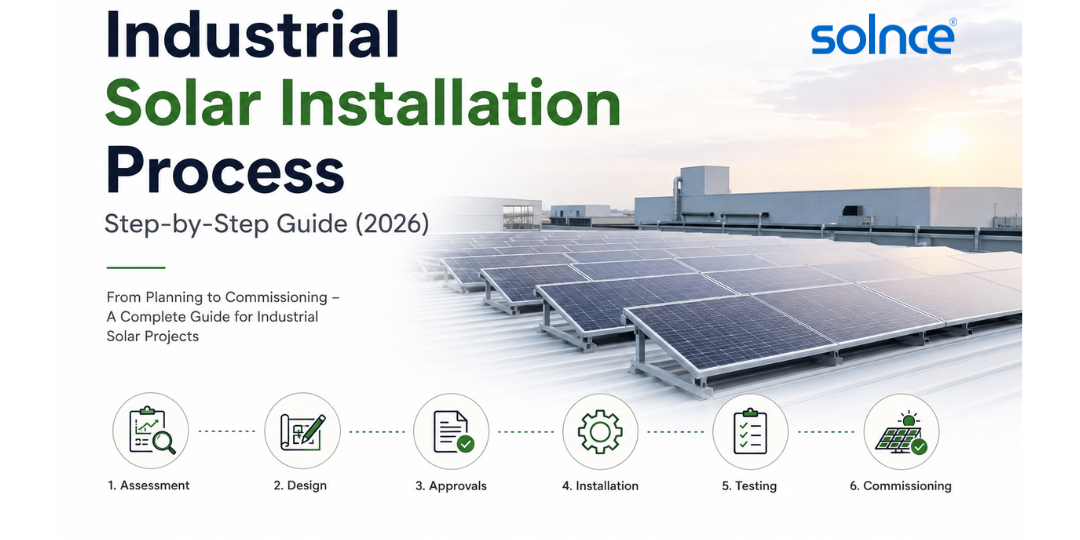
A Complete Guide to Planning, Designing, Installing & Commissioning an Industrial Solar Power System in India
By Solnce Energy
Industrial Solar Installation Process: Step-by-Step
Electricity is one of the largest operating expenses for manufacturing plants, factories, warehouses, commercial buildings, and industrial facilities. As electricity tariffs continue to rise across India, more businesses are investing in solar power to reduce operational costs, improve sustainability, and become less dependent on conventional grid electricity.
However, installing an industrial solar power system is not as simple as placing solar panels on a roof. Every successful project involves detailed engineering, structural analysis, electrical design, government approvals, procurement, installation, testing, commissioning, and long-term monitoring.
A properly designed industrial solar system can reduce electricity bills by 50–80%, deliver a return on investment within 3–5 years, and continue generating clean energy for more than 25 years.
Whether you own a textile mill in Surat, a pharmaceutical manufacturing unit in Ankleshwar, a chemical plant in Dahej, or a logistics warehouse anywhere in India, understanding the industrial solar installation process helps you make better investment decisions and choose the right EPC partner.
This guide explains every stage of an industrial solar installation—from the first energy assessment to final commissioning—so you know exactly what happens before, during, and after your solar plant is installed.
Industrial solar installation is a structured engineering process that includes energy analysis, site survey, feasibility assessment, structural evaluation, detailed system design, statutory approvals, procurement of quality components, mounting structure installation, solar panel installation, electrical integration, testing, commissioning, and long-term operations & maintenance.
Depending on project size, roof condition, approval timelines, and site complexity, a typical industrial solar installation in India takes 4–12 weeks from project approval to commissioning.
What is an Industrial Solar Installation?
An industrial solar installation refers to the complete process of designing and installing a solar photovoltaic (PV) power system for industrial or commercial facilities.
Unlike residential rooftop systems, industrial projects are significantly larger, technically more complex, and require extensive engineering and compliance with electrical and structural standards.
Industrial solar projects are commonly installed for:
- Manufacturing plants
- Textile industries
- Pharmaceutical companies
- Chemical factories
- Food processing units
- Engineering industries
- Plastic manufacturing
- Warehouses
- Cold storage facilities
- Commercial office buildings
- Shopping malls
- Hospitals
- Educational institutions
- Industrial parks
Project capacities generally range from 20 kW to several megawatts (MW), depending on the facility's electricity consumption.
Why More Industries in India Are Investing in Solar
Industrial electricity tariffs have steadily increased over the past decade. At the same time, businesses face growing pressure to improve sustainability, reduce operating costs, and meet ESG (Environmental, Social & Governance) commitments.
Solar power addresses all three challenges.
1. Significant Reduction in Electricity Bills
Electricity often represents one of the highest recurring expenses for industrial facilities. Solar power enables businesses to generate electricity on-site, reducing the amount of power purchased from the DISCOM.
Many industries achieve savings of 50–80% on their daytime electricity consumption, depending on system size and operating profile.
2. Faster Return on Investment
Industrial solar systems generally recover their investment within 3–5 years through reduced electricity costs. Since quality solar panels continue producing electricity for over 25 years, businesses benefit from decades of low-cost energy after the payback period.
3. Protection Against Rising Electricity Tariffs
Grid electricity prices rarely remain constant. Annual tariff revisions can significantly increase operating costs over time.
A solar power system helps stabilize energy expenses by generating electricity at a predictable cost throughout its operational life.
4. Improved ESG & Sustainability Performance
Many multinational corporations and export customers now prefer suppliers that actively reduce carbon emissions.
Installing solar demonstrates a company's commitment to sustainability, strengthens ESG performance, and enhances brand reputation among customers, investors, and stakeholders.
5. Better Energy Independence
Although most industrial solar plants remain connected to the grid, generating electricity on-site reduces dependence on external power sources and minimizes the financial impact of future tariff increases.
6. Attractive Financial Benefits
Industries can choose from multiple investment models, including:
- CAPEX (self-owned systems)
- RESCO / OPEX models
- Power Purchase Agreements (PPA)
- Solar financing through banks or NBFCs
These options allow businesses to adopt solar without significantly affecting cash flow.
Types of Industrial Solar Installations
Every industrial facility has unique energy requirements and site conditions. The installation method depends on available roof space, land availability, electricity consumption, and project objectives.
Industrial Rooftop Solar Installation
Solar panels are mounted on factory roofs, warehouses, industrial sheds, commercial buildings, or institutional campuses.
Suitable for:
- Textile units
- Pharmaceutical companies
- Engineering industries
- Commercial complexes
- Warehouses
- Hospitals
- Educational institutions
Advantages
- Utilizes existing roof space
- Lower project cost compared to ground-mounted systems
- Minimal land requirement
- Faster installation
- Lower transmission losses
- Easier maintenance
Ground-Mounted Solar Installation
When rooftop space is insufficient, industries install solar plants on available land.
Ground-mounted systems are commonly used for:
- Large manufacturing facilities
- Industrial parks
- Open-access projects
- Captive solar plants
- Utility-scale installations
Advantages
- Easy maintenance access
- Higher design flexibility
- Better ventilation for modules
- Simple future expansion
- Suitable for MW-scale projects
Solar Carport Systems
Instead of leaving parking areas unused, industries can install elevated solar structures over vehicle parking spaces.
Solar carports provide dual benefits:
- Clean energy generation
- Covered parking for employees and visitors
They are increasingly popular among corporate campuses, IT parks, educational institutions, and commercial facilities.
Open Access Solar Projects
Industries with very high electricity consumption often procure power from off-site solar plants through Open Access regulations.
Instead of installing panels on-site, businesses purchase solar electricity generated at a remote location and transmitted through the utility grid.
This model is particularly suitable for companies with limited rooftop area but high annual energy consumption.
Captive Solar Power Plants
Large industrial groups often develop dedicated captive solar plants to meet the energy needs of one or more manufacturing facilities.
Captive projects offer greater control over energy costs and are widely adopted by energy-intensive industries such as chemicals, cement, metals, and heavy manufacturing.
Major Components of an Industrial Solar Power System
Before understanding the installation process, it is important to understand the key components that work together to generate clean electricity.
Solar PV Modules
Solar panels capture sunlight and convert it into direct current (DC) electricity. Most modern industrial projects use high-efficiency TOPCon or Mono PERC modules due to their higher output, durability, and lower degradation.
Solar Inverters
Inverters convert DC electricity into alternating current (AC), making it suitable for industrial equipment and grid synchronization. Depending on project size, industries may use string inverters, central inverters, or hybrid inverters.
Mounting Structures
Hot-dip galvanized steel or aluminium structures securely support solar panels and are engineered to withstand wind loads, corrosion, and long-term outdoor exposure.
Electrical Components
A typical industrial system also includes DC cables, AC cables, junction boxes, DCDBs, ACDBs, protection devices, isolators, circuit breakers, surge protection devices, and transformers where required.
Monitoring System
Modern industrial solar plants often incorporate SCADA or cloud-based monitoring systems, which provide real-time insights into energy generation, plant performance, fault alerts, and system efficiency. This enables plant owners to track performance remotely and identify issues before they affect production.
The Industrial Solar Installation Process: Step-by-Step
Every successful industrial solar project follows a systematic engineering workflow. Skipping or rushing any stage can lead to poor energy generation, structural issues, delays in approvals, or higher maintenance costs.
Let's understand each step in detail.
Step 1: Energy Audit & Electricity Bill Analysis
Every industrial solar project begins with understanding how the facility consumes electricity.
Before recommending the system size, a Solar EPC company performs an energy audit by analysing the industry's electricity consumption pattern.
The audit generally includes:
- Last 12 months electricity bills
- Connected load
- Contract demand
- Maximum Demand (MD)
- Monthly units consumed
- Power factor
- Time-of-Day (TOD) tariff
- DG set usage
- Future expansion plans
- Operating hours (single shift, double shift, or 24×7)
This information helps engineers determine:
- The ideal solar system capacity
- Expected annual energy generation
- Potential electricity savings
- Return on investment (ROI)
- System payback period
Example
A textile factory consuming 1,20,000 units per month will require a significantly different solar solution compared to a pharmaceutical company consuming the same units but operating only during daytime.
That's why analysing consumption patterns is more important than simply looking at the electricity bill amount.
Why this step matters
An undersized system delivers lower savings, while an oversized system may generate excess electricity that cannot always be fully utilized depending on applicable regulations and the facility's load profile.
A properly conducted energy audit ensures that the solar plant is correctly sized for maximum financial benefit.
Step 2: Site Survey & Feasibility Study
Once the preliminary system capacity is estimated, engineers conduct a detailed site survey.
The objective is to determine whether the site is technically suitable for solar installation.
During the survey, engineers evaluate:
- Roof dimensions
- Roof type (RCC or metal sheet)
- Building height
- Structural condition
- Orientation
- Available shadow-free area
- Existing electrical infrastructure
- Cable routing
- Transformer location
- Inverter installation area
- Accessibility for maintenance
- Safety hazards
The survey also identifies possible challenges that may affect project execution.
For example:
- HVAC equipment occupying roof space
- Water tanks
- Chimneys
- Ventilation ducts
- Skylights
- Future building expansion
- Weak roofing sections
All these factors influence the final plant design.
Types of Roofs Used for Industrial Solar
RCC Roof
Advantages
- Strong structural support
- Long service life
- Suitable for ballast structures
- Easy maintenance access
Challenges
- Waterproofing precautions
- Additional structural loading
Metal Sheet Roof
Advantages
- Lightweight installation
- Faster construction
- Lower mounting cost
Challenges
- Roof thickness verification
- Corrosion assessment
- Clamp compatibility
- Wind uplift calculations
Step 3: Shadow Analysis
Solar panels generate maximum electricity only when they receive uninterrupted sunlight.
Even a small shadow on one panel can reduce the output of an entire string if not properly designed.
During the feasibility study, engineers perform a shadow analysis using specialized software and site observations.
They identify potential shading caused by:
- Nearby buildings
- Water tanks
- Chimneys
- Cooling towers
- Trees
- Mobile towers
- Sign boards
- Utility poles
- Future construction
The objective is to maximize annual energy generation.
Modern design software can even simulate how shadows move throughout the year, ensuring optimal panel placement.
Why Shadow Analysis is Important
A shadow affecting just one module for a few hours each day can significantly reduce annual energy production.
Proper layout planning helps avoid unnecessary energy losses over the system's lifetime.
Step 4: Structural Assessment
One of the most critical stages of industrial solar installation is structural analysis.
Solar panels, mounting structures, walkways, and maintenance personnel all add load to the building.
Before installation begins, structural engineers verify that the roof can safely support these additional loads.
The assessment includes:
- Roof strength
- Existing structural drawings
- Beam locations
- Column spacing
- Wind load calculations
- Dead load analysis
- Live load analysis
- Seismic considerations
- Corrosion inspection
If required, structural reinforcement recommendations are provided before installation.
Wind Load Calculations
Industrial roofs are exposed to strong winds, particularly in coastal states such as Gujarat.
Engineers design mounting structures according to applicable Indian Standards, considering factors such as:
- Wind speed zone
- Building height
- Terrain category
- Roof profile
- Panel tilt angle
Proper wind-resistant design prevents panel movement and ensures long-term reliability.
Step 5: System Design & Engineering
Once site feasibility is confirmed, the engineering team begins designing the solar power system.
This stage determines how efficiently the plant will perform for the next 25 years.
The design process includes:
Solar Plant Capacity
Engineers determine the final installed capacity based on:
- Available roof space
- Energy consumption
- Budget
- Future expansion
- Utility regulations
PV Module Layout
The exact location of every solar panel is planned to maximize sunlight exposure while maintaining service walkways and safe maintenance access.
The layout considers:
- Roof obstructions
- Tilt angle
- Module spacing
- Wind effects
- Drainage
- Future maintenance
Inverter Selection
Depending on project size, engineers select:
- String Inverters
- Central Inverters
- Multi-MPPT Inverters
Selection depends on:
- Roof layout
- Shading conditions
- Redundancy requirements
- Ease of maintenance
- System efficiency
String Design
Solar modules are connected in strings.
Engineers calculate:
- Maximum string voltage
- Minimum operating voltage
- Current
- Temperature correction factors
- MPPT compatibility
Incorrect string sizing can reduce inverter efficiency and system output.
DC/AC Ratio
The DC-to-AC ratio determines how much solar panel capacity is connected to the inverter.
A properly optimized DC/AC ratio improves annual energy generation without unnecessarily increasing equipment costs.
Cable Sizing
Electrical engineers calculate cable sizes based on:
- Voltage drop
- Current carrying capacity
- Ambient temperature
- Cable route length
- Future expansion
Proper cable selection improves efficiency and reduces energy losses.
Single Line Diagram (SLD)
An SLD is prepared showing the complete electrical architecture of the solar plant.
It includes:
- PV strings
- Combiner boxes
- Inverters
- ACDB
- LT Panel
- Transformer (if applicable)
- HT connection
- Utility interface
- Protection systems
The SLD becomes the reference document for installation, approvals, and maintenance.
Step 6: Generation Estimation & ROI Analysis
Before the client approves the project, the EPC company estimates the plant's expected performance.
Using professional simulation software, engineers calculate:
- Annual energy generation (kWh)
- Performance Ratio (PR)
- Specific Yield
- Capacity Utilization Factor (CUF)
- Annual savings
- Carbon emission reduction
- Return on Investment
- Internal Rate of Return (IRR)
- Payback period
These estimates help businesses evaluate the financial viability of the project.
For most industrial projects in India, the solar payback period ranges from 3–5 years, depending on electricity tariffs, system utilization, and financing model.
Step 7: Statutory Approvals & Documentation
Before installation begins, several approvals may be required depending on project size, state regulations, and the connection type.
Typical approvals include:
- DISCOM application
- Net Metering or Gross Metering approval
- CEIG approval (where applicable)
- Electrical inspector approvals
- Synchronization permission
- Transformer approvals (if required)
- Safety compliance documentation
An experienced EPC company coordinates these approvals to ensure smooth project execution and avoid delays.
Step 8: Procurement & Quality Assurance
After approvals are in place, the procurement team begins sourcing project components.
Only quality-certified equipment should be used to ensure long-term reliability and performance.
The procurement process includes:
- Solar PV modules
- Inverters
- Mounting structures
- DC & AC cables
- Junction boxes
- DCDB & ACDB
- Earthing materials
- Lightning arresters
- Monitoring systems
- Fasteners and hardware
Before dispatch to the site, components undergo quality checks to verify specifications, certifications, and physical condition.
Using trusted manufacturers and following strict quality control practices helps minimize installation issues and supports reliable plant performance over its lifetime.
Step 9: Mounting Structure Installation
Once all engineering drawings are approved and materials arrive at the site, the physical installation begins with the mounting structure.
The mounting structure forms the foundation of the entire solar power plant. It supports the solar panels for over 25 years while withstanding wind loads, rain, temperature fluctuations, and other environmental conditions.
Depending on the project, structures are manufactured using Hot-Dip Galvanized (HDG) Steel or Aluminium, both of which offer excellent corrosion resistance and long service life.
The choice of mounting structure depends on:
- Roof type (RCC or metal sheet)
- Wind speed zone
- Panel orientation
- Tilt angle
- Roof load-bearing capacity
- Local weather conditions
Installation Process
The mounting structure is assembled using precision-engineered components.
For RCC roofs, ballast or anchor fasteners are used depending on the structural design.
For metal sheet roofs, specially designed clamps are installed to avoid roof leakage while maintaining structural integrity.
After installation, engineers verify:
- Structure alignment
- Bolt tightening torque
- Corrosion protection
- Verticality
- Module spacing
- Walkway clearance
Proper installation at this stage ensures the solar plant remains safe and stable throughout its operational life.
Importance of Tilt Angle
Solar panels should be installed at an optimized tilt angle to maximize annual energy generation.
Although the ideal angle varies by location, most industrial rooftop installations in India use a tilt that balances annual generation, structural loading, and available roof space.
Factors influencing tilt include:
- Geographic location
- Roof orientation
- Wind loading
- Inter-row shading
- Maintenance accessibility
A poorly designed tilt can reduce energy generation over the plant's lifetime.
Step 10: Solar Panel Installation
Once the mounting structure is complete, solar modules are carefully installed.
Each module is inspected before installation to ensure there are no cracks, scratches, or transportation damage.
Technicians follow the approved module layout and install panels row by row.
During installation they verify:
- Module orientation
- Correct polarity
- Uniform spacing
- Clamp positioning
- Torque values
- Cable routing
Improper handling of solar modules can cause invisible micro-cracks that reduce long-term performance.
Professional EPC companies therefore use trained technicians and proper lifting techniques throughout installation.
Quality Checks During Module Installation
Before moving to electrical work, engineers inspect:
- Module serial numbers
- Correct clamp locations
- Glass condition
- Junction box integrity
- Cable connectors
- Panel alignment
- Mechanical stability
Any damaged modules are replaced immediately.
Step 11: DC Electrical Installation
After module installation, the DC electrical system is completed.
Solar panels generate Direct Current (DC), which must safely reach the inverter.
This stage includes installation of:
- Solar DC cables
- MC4 connectors
- String combiner boxes (if applicable)
- Junction boxes
- Cable trays
- UV-resistant conduits
- Cable markers
- String identification labels
Cable routing is planned carefully to avoid:
- Water accumulation
- Mechanical damage
- Excessive cable bending
- UV degradation
- Rodent damage
All cable terminations are checked for continuity and polarity before energizing the system.
DC Protection System
Industrial solar plants include multiple protection devices to safeguard equipment.
Typical DC protection includes:
- DC Isolators
- String Fuses
- Surge Protection Devices (SPD)
- Reverse polarity protection
- Overcurrent protection
These components improve plant safety and reduce equipment damage during abnormal operating conditions.
Step 12: Inverter Installation
The inverter is often referred to as the "heart" of the solar power plant.
It converts DC electricity produced by the solar panels into AC electricity that can be consumed by industrial equipment or exported to the utility grid.
Depending on the project size, industries may use:
- String Inverters
- Central Inverters
- Hybrid Inverters (special applications)
The installation location is selected carefully to provide:
- Adequate ventilation
- Easy maintenance access
- Protection from direct sunlight where appropriate
- Safe operating conditions
- Short cable routes
After installation, engineers configure inverter settings according to the approved electrical design.
Parameters Configured
A typical inverter configuration includes:
- Grid voltage
- Frequency
- MPPT settings
- Export limitation (if applicable)
- Grid synchronization
- Communication settings
- Monitoring integration
Correct commissioning ensures optimum system efficiency.
Step 13: AC Electrical Works
Once the inverter is operational, AC electrical integration begins.
This stage connects the solar plant to the facility's electrical distribution system.
The installation generally includes:
- AC cables
- AC Distribution Board (ACDB)
- MCCB
- ACB
- Protection relays
- Energy meter
- Synchronization panel
- Transformer connection (if required)
Electrical engineers ensure that the solar plant integrates safely with the existing LT or HT infrastructure.
Grid Synchronization
Grid synchronization is a critical process.
The inverter continuously monitors:
- Voltage
- Frequency
- Phase sequence
Power is exported only when these parameters remain within permissible limits.
If abnormalities occur, the inverter automatically disconnects to protect personnel and utility equipment.
Step 14: Earthing & Lightning Protection
Industrial solar plants contain significant electrical equipment exposed to outdoor conditions.
Proper earthing and lightning protection are therefore essential for safety.
A complete earthing system generally includes:
- Module earthing
- Structure earthing
- Inverter earthing
- Lightning arrester earthing
- Equipment earthing
Separate earth pits are usually installed according to project requirements and applicable electrical standards.
Why Earthing is Critical
An effective earthing system helps:
- Prevent electric shocks
- Protect equipment
- Reduce fault current
- Improve inverter performance
- Minimize fire risks
- Increase system reliability
Poor earthing remains one of the leading causes of inverter failures in poorly executed solar projects.
Step 15: Monitoring System & SCADA Integration
Modern industrial solar plants are equipped with intelligent monitoring platforms.
These systems allow businesses to track plant performance in real time using a computer or smartphone.
Typical monitoring parameters include:
- Current power generation
- Daily generation
- Monthly generation
- Annual generation
- Specific Yield
- Performance Ratio (PR)
- Inverter efficiency
- Grid export/import
- Fault notifications
Large industrial projects often integrate with SCADA (Supervisory Control and Data Acquisition) systems, enabling centralized monitoring of multiple plants from a single dashboard.
Real-time monitoring helps detect issues early, reduce downtime, and optimize long-term energy production.
Step 16: Safety Standards Followed During Installation
Industrial solar installation involves working at heights, live electrical systems, and heavy equipment. Safety is therefore a top priority throughout the project.
Professional EPC companies implement comprehensive safety measures, including:
- Full-body safety harnesses for rooftop work
- Safety helmets, gloves, and protective footwear
- Fall arrest systems and lifelines
- Barricading of work areas
- Lockout/Tagout (LOTO) procedures
- Fire extinguishers at the worksite
- Daily toolbox talks and safety briefings
- Electrical isolation before commissioning
- Compliance with applicable IS and IEC standards
A strong safety culture not only protects workers but also ensures smooth project execution without accidents or unnecessary delays.
Step 17: Testing & Commissioning
After the complete installation of the solar power plant, the project enters one of its most critical phases—testing and commissioning.
At this stage, engineers verify that every component is functioning correctly, all safety standards have been met, and the plant is ready to generate electricity safely and efficiently.
Testing is never just a formality. It ensures the system will operate reliably for decades while minimizing the risk of faults or downtime.
A comprehensive commissioning process typically includes:
- Visual inspection of all installed equipment
- Mechanical inspection of mounting structures
- Torque verification of all fasteners
- DC polarity checks
- Cable continuity testing
- Insulation Resistance (IR) testing
- Earth resistance testing
- Inverter parameter verification
- Grid synchronization testing
- Protection relay testing
- Performance verification
- SCADA communication testing
Only after all tests are successfully completed is the plant declared ready for commercial operation.
DC Side Testing
The DC side of the plant is tested before the inverter is energized.
Typical tests include:
- Open Circuit Voltage (Voc)
- Short Circuit Current (Isc)
- String polarity verification
- Connector inspection
- Cable insulation resistance
- Continuity testing
These tests ensure every solar string is connected correctly and capable of delivering the expected output.
AC Side Testing
After DC verification, engineers inspect the AC side.
Typical tests include:
- Phase sequence verification
- Voltage measurement
- Frequency verification
- Protection relay testing
- Circuit breaker functionality
- Grid synchronization
- Transformer testing (if applicable)
Only after successful AC testing is the inverter synchronized with the utility grid.
Step 18: Plant Commissioning
Commissioning marks the official start of electricity generation.
Once all approvals are obtained and testing is completed, the inverter is synchronized with the utility grid.
During commissioning, engineers monitor:
- Instantaneous power output
- Grid voltage
- Grid frequency
- Power factor
- Inverter efficiency
- Communication system
- Energy meter readings
- Export and import values
The plant is then observed for several hours or days to ensure stable operation before being handed over to the client.
Step 19: Performance Monitoring
A solar power plant should never become a "set it and forget it" asset.
Continuous monitoring is essential to ensure the system consistently performs at its expected efficiency.
Modern industrial solar plants use cloud-based monitoring software that provides:
- Live power generation
- Daily energy production
- Monthly generation reports
- Annual performance reports
- Plant efficiency
- Inverter status
- Fault alerts
- Performance Ratio (PR)
- Carbon emission savings
Facility managers can access this information remotely through a desktop or mobile application.
This enables proactive maintenance and minimizes generation losses.
Step 20: Operations & Maintenance (O&M)
Although solar plants require relatively low maintenance compared to conventional power systems, regular maintenance is essential for maximizing energy generation and extending equipment life.
A professional O&M program generally includes:
- Periodic module cleaning
- Inverter inspection
- Electrical tightening
- Thermographic inspection
- Earthing resistance testing
- SPD inspection
- Lightning protection verification
- Vegetation control (ground-mounted plants)
- Performance analysis
- Preventive maintenance scheduling
Industries that follow a structured maintenance program typically achieve higher energy yields and lower lifecycle costs.
Industrial Solar Installation Cost in India (2026)
Project costs vary depending on factors such as system capacity, panel technology, inverter brand, roof type, mounting structure, and electrical infrastructure.
The following figures provide indicative market ranges for complete EPC projects.
| System Capacity |
Approximate Cost* |
| 20 kW |
₹9–12 lakh |
| 30 kW |
₹13–17 lakh |
| 50 kW |
₹20–28 lakh |
| 100 kW |
₹38–55 lakh |
| 250 kW |
₹90 lakh – ₹1.3 crore |
| 500 kW |
₹1.8 – ₹2.6 crore |
| 1 MW |
₹3.5 – ₹5 crore |
*Approximate prices may vary depending on module type, inverter, structure, location, installation, and project requirements.
*Indicative values only. Actual pricing depends on project specifications, component selection, location, and market conditions.
Factors Affecting Industrial Solar Installation Cost
No two industrial solar projects are exactly alike. Several factors influence the overall project cost.
System Capacity
Larger systems generally benefit from economies of scale, reducing the cost per kilowatt.
Roof Type
Installation on RCC roofs, metal sheet roofs, or ground-mounted structures involves different engineering requirements and costs.
Solar Panel Technology
High-efficiency TOPCon and N-Type modules may have a higher upfront cost but can improve long-term energy generation.
Inverter Selection
String, central, or hybrid inverters vary in cost, efficiency, and maintenance requirements.
Electrical Infrastructure
Existing transformers, LT panels, HT connections, and cable routes can significantly affect project costs.
Structural Reinforcement
If the roof requires strengthening before installation, additional civil work may be necessary.
Approval Requirements
Some projects require additional inspections or approvals, increasing project duration and cost.
Expected ROI & Payback
Industrial solar is one of the highest-return infrastructure investments available to businesses.
Typical financial performance:
- Electricity bill reduction: 50–80%
- Payback period: 3–5 years
- System life: 25+ years
- Annual degradation: Typically, less than 0.5% for high-quality modules
- Return on Investment (ROI): Highly dependent on tariffs, load profile, financing, and system utilization
Since electricity tariffs generally increase over time, the financial benefits of solar often become even more attractive in the later years of operation.
Common Mistakes Industries Should Avoid
Even a high-quality solar plant can underperform if basic planning principles are ignored.
Some of the most common mistakes include:
Choosing the Lowest Bid Instead of the Best EPC Partner
The cheapest proposal may compromise on engineering, equipment quality, or after-sales service, leading to higher costs over the system's lifetime.
Ignoring Structural Analysis
Installing a solar plant without verifying the roof's load-bearing capacity can create long-term safety and maintenance issues.
Selecting Low-Quality Components
Inferior panels, inverters, or mounting structures often result in lower energy generation and higher failure rates.
Oversizing or Undersizing the System
A system should be designed based on the facility's actual electricity consumption and future expansion plans—not simply to maximize capacity.
Neglecting O&M
Regular cleaning, inspections, and preventive maintenance are essential to maintain optimal performance throughout the plant's life.
Poor Monitoring Practices
Without continuous performance monitoring, minor issues can go unnoticed, resulting in significant generation losses over time.
Industrial Solar Installation Checklist
Before starting your project, ensure the following:
- Review the last 12 months of electricity bills
- Conduct a detailed site survey
- Perform a structural assessment
- Complete shadow analysis
- Verify available installation area
- Finalise system capacity
- Select Tier-1 solar modules and reputable inverter brands
- Confirm applicable approvals
- Choose an experienced EPC contractor
- Establish a preventive maintenance plan
Why Choosing the Right Solar EPC Company Matters
An industrial solar power plant is a long-term investment expected to operate efficiently for more than 25 years. While high-quality components such as solar panels and inverters are important, the expertise of the EPC (Engineering, Procurement & Construction) company ultimately determines how well the system performs over its lifetime.
A professional EPC partner is responsible for much more than installation. They ensure the project is correctly designed, complies with safety standards, is executed efficiently, and continues delivering reliable performance year after year.
When selecting an industrial solar EPC company, consider the following factors:
- Proven experience with commercial and industrial projects
- Qualified in-house engineering and design team
- Use of Tier-1 solar modules and trusted inverter brands
- Strong project management capabilities
- Compliance with Indian electrical and safety standards
- End-to-end support, including approvals and commissioning
- Transparent project timelines and communication
- Comprehensive Operations & Maintenance (O&M) services
- Performance monitoring and after-sales support
- Strong customer references and completed installations
Choosing the right EPC partner helps minimize project risks, maximize energy generation, and ensure a faster return on investment.
Why Businesses Choose Solnce Energy
At Solnce Energy, we provide complete Engineering, Procurement & Construction (EPC) solutions for commercial and industrial solar projects across Gujarat and India.
From the first site visit to long-term maintenance, our team manages every stage of the project with a focus on quality, safety, and performance.
Our services include:
- Energy audit and consumption analysis
- Detailed site survey and feasibility study
- Structural assessment
- Customized solar system design
- Financial analysis and ROI estimation
- DISCOM approvals and documentation support
- Procurement of premium-quality components
- Professional installation by trained engineers
- Testing and commissioning
- Real-time monitoring integration
- Preventive maintenance and annual O&M support
Whether you are planning a 50 kW rooftop solar system or a multi-megawatt industrial solar plant, Solnce Energy delivers solutions designed to maximize energy savings and long-term business value.
Ready to Reduce Your Industrial Electricity Costs?
If your business is looking to lower electricity expenses, improve sustainability, and achieve long-term energy independence, investing in industrial solar is one of the smartest decisions you can make.
At Solnce Energy, we help industries design and install customized solar power systems that deliver reliable performance and measurable savings.
Whether you need a 50 kW rooftop system or a 1 MW+ industrial solar plant, our experts can help you evaluate the best solution for your facility.
Get a free industrial solar consultation today.
📧 Email: support@solnceenergy.com
🌐 Website: www.solnceenergy.com
Frequently Asked Questions (FAQs)
1. What is an industrial solar installation?
An industrial solar installation is the process of designing, installing, and commissioning a solar photovoltaic (PV) system for factories, warehouses, manufacturing plants, and commercial facilities to reduce electricity costs.
2. How long does an industrial solar installation take?
Most industrial solar projects are completed within 4–12 weeks, depending on project size, engineering complexity, and approval timelines.
3. How much does an industrial solar system cost?
The cost depends on system capacity, equipment selection, roof type, and project scope. Industrial systems can range from approximately ₹9 lakh for a 20 kW plant to several crores for multi-megawatt installations.
4. How much can industries save with solar?
Many businesses reduce their daytime electricity expenses by 50–80%, depending on their energy consumption and system size.
5. What is the payback period for an industrial solar project?
Most industrial solar systems recover their investment within 3–5 years, after which they continue generating low-cost electricity for decades.
6. How long do industrial solar panels last?
High-quality solar panels typically carry a 25-year performance warranty and often continue generating electricity beyond that period.
7. Which industries benefit most from solar?
Industries with high daytime electricity consumption—such as textile, pharmaceutical, chemical, engineering, food processing, plastics, logistics, and manufacturing—benefit significantly from solar power.
8. Can industrial solar systems operate during cloudy weather?
Yes. Solar panels continue generating electricity during cloudy conditions, although output is lower than on sunny days.
9. Do industrial solar systems require batteries?
Most industrial rooftop systems are grid-connected and do not require batteries. Battery storage is used only when backup power or energy storage is needed.
10. What approvals are required for industrial solar installation?
Depending on the project, approvals may include DISCOM permissions, net or gross metering approval, CEIG approval (where applicable), and synchronization approval.
11. What is net metering?
Net metering allows industries to export surplus solar electricity to the grid and receive credits that offset future electricity consumption, subject to applicable regulations.
12. What maintenance does an industrial solar plant require?
Routine maintenance includes module cleaning, inverter inspections, electrical checks, earthing verification, thermographic inspections, and performance monitoring.
13. Can solar panels withstand heavy rain and strong winds?
Yes. Properly engineered industrial solar systems are designed to withstand local wind loads and weather conditions while complying with relevant structural standards.
14. What is SCADA in a solar power plant?
SCADA (Supervisory Control and Data Acquisition) is a monitoring system that provides real-time information on plant performance, energy generation, alarms, and equipment status.
15. How much roof space is required?
As a general guideline, around 90–100 sq. ft. of shadow-free area is required per kW, although the exact requirement depends on module dimensions and system design.
16. Can an existing factory install rooftop solar?
Yes. Most existing factories can install rooftop solar after a site survey and structural assessment confirm the roof's suitability.
17. Is industrial solar suitable for metal sheet roofs?
Yes. Metal sheet roofs are commonly used for industrial rooftop solar installations. Proper clamps, structural verification, and waterproof installation techniques are essential.
18. What factors affect annual solar energy generation?
Energy generation depends on solar irradiation, module efficiency, system design, orientation, tilt angle, shading, weather conditions, and maintenance practices.
19. How do I choose the right industrial solar EPC company?
Look for experience, engineering expertise, high-quality components, strong safety practices, transparent pricing, proven project execution, and reliable after-sales support.
20. Why should I choose Solnce Energy?
Solnce Energy offers end-to-end industrial solar EPC services—from design and approvals to installation, commissioning, and long-term maintenance—helping businesses reduce energy costs with reliable, high-performance solar solutions.
Conclusion
Industrial solar has become one of the most effective ways for businesses to control energy costs while advancing sustainability goals. A successful project, however, depends on much more than choosing quality solar panels. It requires careful planning, detailed engineering, regulatory compliance, professional installation, and ongoing maintenance.
By following a structured installation process and partnering with an experienced EPC company, industries can maximize energy generation, improve operational efficiency, and secure long-term financial returns.
Whether you're considering a 50 kW rooftop system for a warehouse or a 1 MW solar plant for a manufacturing facility, investing in solar today can provide decades of predictable, low-cost clean energy.