QUICK ANSWER
Industrial solar rooftop systems for Indian factories typically range 100 kW to 5 MW, need 8–14 sq m of roof area per kW, and take 90–150 days from kickoff to commissioning.
Three execution models work: CAPEX (self-owned), PPA (zero upfront) and Roof Lease.
A 500 kW system on a metal-sheet factory roof costs ₹1.8–2.2 crore CAPEX, generates ~7.8 lakh units/year, and pays back in 2.5–3.5 years post-tax for tax-paying industrial owners.
Net metering is the standard model in most states, but several have moved HT-industrial to gross metering — verify with your DISCOM.
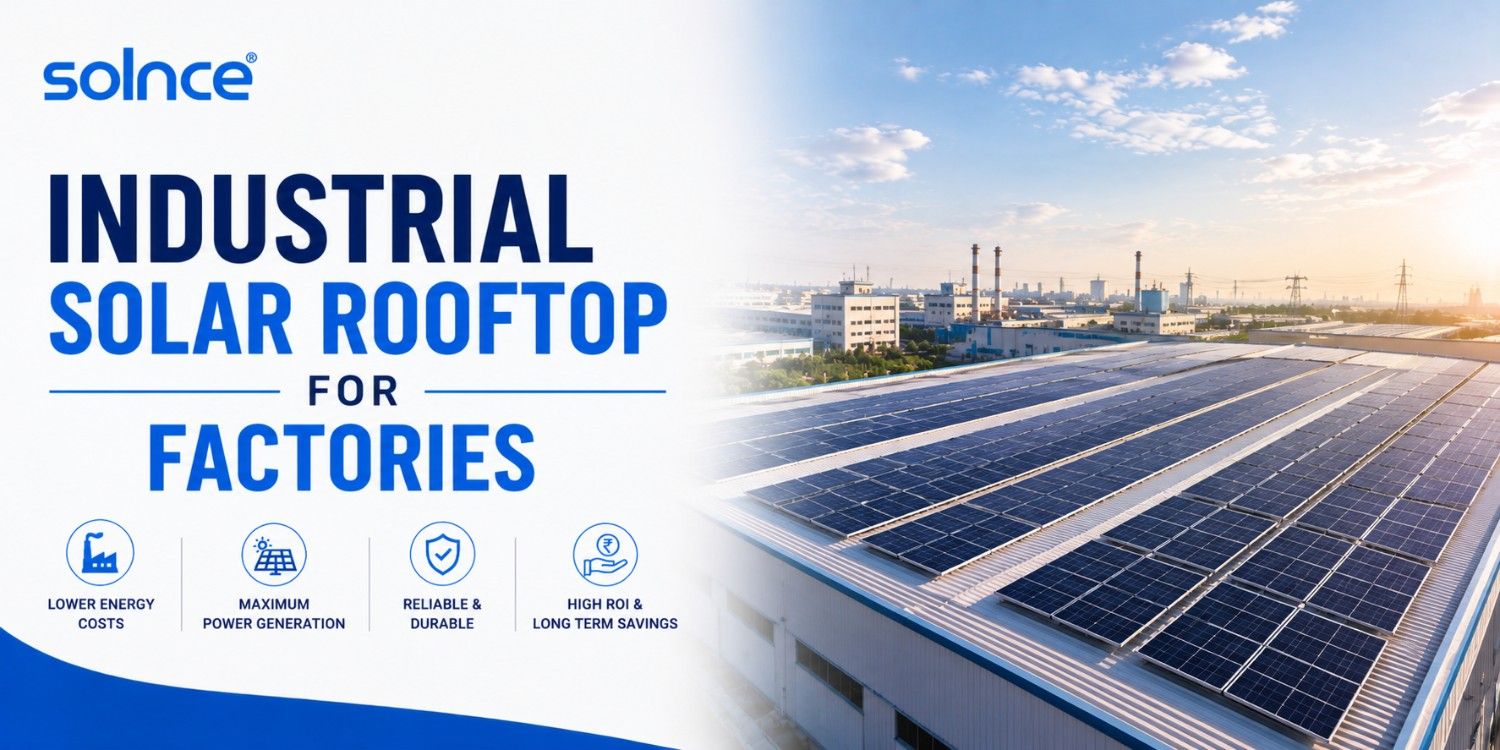
For Indian factory owners, the rooftop above your shop floor is the most underutilised asset on your balance sheet. A typical 30,000 sq ft metal-sheet industrial roof can host a 350–400 kW solar plant generating roughly 5.5 lakh units a year —covering 40–80% of a mid-size factory's electricity consumption. With industrial DISCOM tariffs at ₹7–₹11/unit and rising 6–8% annually, the rooftop solar opportunity is no longer about sustainability. It's the highest-ROI capital deployment available to most industrial CFOs in India today. This guide is the complete execution playbook for factory and industrial-building rooftop solar in 2026.
1. Who Industrial Rooftop Solar Is For
Industrial rooftop solar is the right choice when your facility has all four of these characteristics:
• Monthly electricity consumption above 10,000 units (typical threshold where industrial solar pays back fast)
• A shade-free, structurally sound roof of at least 1,000 sq m (around 10,000 sq ft) — though smaller systems work on smaller roofs
• An HT or LT-industrial DISCOM tariff above ₹6/unit (the higher the tariff, the faster the payback)
• A long-term occupancy horizon — your business owns the building, or you have ≥10 years of secured tenancy
Typical industries where industrial rooftop solar performs best in India: textile and apparel manufacturing, plastics and packaging, food processing, pharmaceuticals, automotive ancillaries, electronics assembly, cold storage and warehousing, IT parks and SEZs, hospitality (hotels and resorts), educational institutions and hospitals. Most have day-time-heavy consumption patterns that align well with solar generation curves.
2. Roof Assessment — What Determines Whether Your Roof Works
Before any quote or design conversation, three roof characteristics determine viability:
| Factor |
What to Evaluate |
| Structural Capacity |
Existing roof structure must bear an additional 12–18 kg/sq m of solar load (modules + mounting + wind uplift). Older industrial roofs sometimes need column/truss reinforcement. Always commission a structural certificate from a chartered engineer.
|
| Roof Type & Age |
Metal sheet (Galvalume, color-coated) — best, cheapest mounting, 6–10 year remaining life ideal. RCC — robust, good for ballasted mounting. Asbestos sheets — must be replaced before solar (health + structural). Roofs older than 15 years need life assessment.
|
| Shade-Free Orientation |
South or south-west facing slopes ideal; flat roofs work universally. Map shadow obstructions: water tanks, chimneys, taller adjacent buildings, exhaust ducts. Lost area = lost generation.
|
| Roof Area Available |
Rule of thumb: 10 sq m per kW for tilted mounting on metal roofs; 12–14 sq m per kW for ballasted mounting on flat RCC. A 1 MW plant needs 10,000–14,000 sq m (1.0–1.4 hectare) of usable area.
|
| Access for Installation & O&M |
Roof access ladders, walkways and lifting equipment. SCADA cable routing. Future maintenance access.
|
Why structural assessment matters:
Many older Indian industrial roofs were designed only for self-weight + wind/rain load. Adding 12–18 kg/sq m of solar load over decades-old purlins or trusses can lead to roof deflection, leaks, or in extreme cases collapse during high-wind events.
A ₹50,000 structural audit at the start protects your ₹2 crore solar investment.
3. Sizing Your Industrial Solar System
System sizing balances three constraints: roof area available, electricity consumption to offset, and DISCOM-approved sanctioned load. The right size is the smaller of (a) what your roof can hold, (b) what your consumption justifies, and (c) what your DISCOM will sanction for net metering.
| Factory Size |
Monthly Consumption |
Recommended Solar |
Roof Area Needed |
Approx CAPEX |
| Small Factory |
5,000–15,000 units |
50–150 kW |
5,000–15,000 sq ft |
₹22–62 lakh |
| Mid-Size Factory |
15,000–50,000 units |
150–500 kW |
15,000–50,000 sq ft |
₹62 lakh–2 cr |
| Large Factory |
50,000–1.5 lakh units |
500 kW–1 MW |
50,000–1.0 lakh sq ft |
₹2–4 cr |
| Industrial Complex |
1.5+ lakh units |
1–5 MW |
1.0–4.0 lakh sq ft |
₹3.5–17 cr |
The standardsizing target is to offset 70–80% of your annual electricity consumption— not 100%. Solar generates only during daylight hours, so a 100% offset meanssignificant export to the grid during noon and significant import at night,which works against you under most state net-metering policies (where exportrates are often lower than import rates).
4. Three Execution Models — CAPEX, PPA, Roof Lease
| Model |
How It Works |
Best For |
| CAPEX |
You buy and own the plant. Pay 100% upfront (or via 70:30 debt:equity loan).
|
Profitable tax-paying companies wanting maximum 25-year value capture and tax depreciation benefits.
|
| PPA |
Developer (e.g. Solnce) owns the plant and sells you power at a fixed tariff (typically ₹3.5–5.5/unit, 25–40% below grid) for 15–25 years. Zero upfront cost.
|
Asset-light or loss-making companies, rented premises, or anyone wanting immediate savings without capital deployment.
|
| Roof Lease |
You lease your unused roof to a solar developer at a fixed rental. Developer owns the plant and sells power to a different offtaker.
|
Industrial building owners with large unused roofs (warehouses, logistics parks) who don’t consume enough power on-site.
|
For most operating factories, the choice is between CAPEX and PPA. The decision pivot is: does your company have tax-paying status and balance sheet appetite to deploy capital? If yes, CAPEX captures the depreciation benefit (40% in year 1 under Section 32) and delivers 20%+ post-tax IRR. If no, or if your CFO prefers operational simplicity, PPA delivers 25–40% tariff savings from day one with zero upfront and no asset-on-books.
5. Net Metering, Gross Metering & Banking — Know Your State
The state's metering and banking policy fundamentally affects how much value you capture from your solar system. Three policy regimes are in use across India in 2026:
| Mechanism |
How It Works |
Best/Worst for Industrial |
| Net Metering |
Surplus solar exported during the day offsets imports at night, on a billing-cycle basis at retail tariff.
|
Best — highest value retention. Available for industrial in most states; some have moved HT to gross metering.
|
| Gross Metering |
All solar exported at fixed feed-in tariff (FIT), typically ₹3–4/unit. All consumption billed at retail.
|
Worst for industrial — significantly lower value capture. Some states (TN, Karnataka) have moved HT-industrial here.
|
| Banking |
Surplus 'banked' with DISCOM during high-generation months, drawn back in low months, subject to 1.5–2% loss.
|
Good complement to net metering, especially for seasonal consumption patterns. Annual settlement applies.
|
Always verify current metering policy with your DISCOM before sizing the system. States change policies periodically — a system designed for net metering can become economically marginal if the state shifts to gross metering during the system life. Maharashtra, Gujarat, Rajasthan, Andhra Pradesh and Telangana currently retain net metering for HT-industrial; Tamil Nadu and Karnataka have moved several segments to gross metering.
6. Approval & Execution Timeline
| # |
Stage |
Duration |
What Happens |
| 1 |
Site Survey & Roof Assessment |
1 Week |
Structural audit, area measurement and shadow analysis. |
| 2 |
Design, Quote & Contract |
2 Weeks |
SLD, BoM, ROI model and contract negotiation. |
| 3 |
DISCOM Application & Feasibility |
2–4 Weeks |
Net-meter application and feasibility approval. |
| 4 |
CEIG Drawing Approval (HT Systems) |
2–4 Weeks |
Required for systems above approximately 100 kW HT-connected. |
| 5 |
Material Procurement & Delivery |
2–4 Weeks (Parallel) |
Modules, inverters, mounting structure and cables. |
| 6 |
Civil & Mechanical Installation |
2–4 Weeks |
Mounting structure installation and module installation. |
| 7 |
Electrical Installation & Cabling |
1–2 Weeks |
DC stringing, inverter installation and AC cabling. |
| 8 |
Pre-Commissioning Testing |
1 Week |
Continuity test, insulation resistance (IR), earth resistance and string testing. |
| 9 |
CEIG Inspection & Energization |
1–2 Weeks |
Mandatory for HT systems before grid connection. |
| 10 |
DISCOM Net-Meter Installation & Commissioning |
1–2 Weeks |
Bi-directional meter installation, joint inspection and Commercial Operation Date (COD). |
7. Six Mistakes That Sink Industrial Rooftop Projects
1. Skipping the structural audit. A 12–18 kg/sq m solar load on an old roof can cause progressive deflection. Always commission a chartered engineer's structural certificate before contract signing.
2. Choosing modules separately from EPC. Self-procured modules void EPC workmanship warranty and complicate ALMM verification. Procure through your EPC.
3. Oversizing for 100% offset. Solar generates only during the day. Sizing for 100% annual consumption means significant exports at low value (under gross metering) or net export limits exceeded. Target 70–80% offset.
4. Ignoring net-metering policy shifts. Verify your state's current policy and any announced shifts. Karnataka moved HT-industrial to gross metering in 2023 — buyers sized under net metering took a 30%+ value hit.
5. Underspending on monitoring. Industrial plants without SCADA/AI monitoring lose 5–10% generation to undetected faults — string failures, inverter throttling, soiling. A ₹2 lakh SCADA system saves several lakh annually.
6. Using the wrong execution model. Tax-paying companies that choose PPA give up the depreciation benefit. Loss-making companies that choose CAPEX cannot use it efficiently. Match the model to your tax/balance sheet position.
8. Real Scenario — A 400 kW Packaging Factory in Pune
· The factory: Plastic packaging manufacturer in Pirangut, Pune. Sanctioned demand: 650 kVA. Monthly consumption: 60,000 units. MSEDCL HT tariff: ₹8.10/unit. Annual electricity bill: ₹58 lakh. Available roof: 22,000sq ft of 2018-vintage metal-sheet roofing on the main production block.
· The assessment: Structural audit confirmed roof can take 14 kg/sq m additional load. No major shadow obstructions. South-east facing main slope(slight orientation loss, ~3%). Maharashtra retains net metering for HT-industrial up to 1 MW.
· The system: 400 kW rooftop grid-tied solar with TOPCon 580W modules (690 panels), 2 × 200 kW Sungrow string inverters, L-foot non-penetrative mounting on existing metal sheet, full BoS, SCADA monitoring. Installed cost:₹1.6 crore. Solnce as EPC + 10-year O&M.
· The financing: The factory is profitable (₹8 crore PAT) and chose CAPEX. Term loan: 70% from a public sector bank @ 9.4%, 10-year tenure. Equity: ₹48lakh. End-to-end execution: 118 days from contract signing to COD.
· The numbers: Annual generation: 6,20,000 units (offsetting ~85% of consumption). Annual savings @ ₹8.10/unit: ₹50 lakh. Year-1depreciation: ₹64 lakh; tax saved @ 30% = ₹19 lakh. Effective post-tax investment: ₹1.41 crore. Simple post-tax payback: ~2.8 years. Post-tax IRR: 22%. 25-year cumulative net savings: ₹11–13 crore on a ₹1.41crore effective investment.
Frequently Asked Questions
1. What is industrial solar rooftop?
Industrial solar rooftop refers to grid-tied solar PV systems installed on factory, warehouse, IT park, hospital or other commercial-industrial building roofs, typically ranging from 100 kW to 5 MW capacity. Power generated is consumed on-site to offset DISCOM electricity costs, with surplus exported under net-metering. Industrial rooftop solar is distinct from utility-scale ground-mounted solar (larger, sold via PPA) and residential rooftop solar (smaller, subsidy-eligible).
2. How much does industrial solar rooftop cost in India in 2026?
Industrial rooftop solar costs ₹35–₹50 per Wp installed in 2026, depending on system size and roof type. A 100 kW system costs ₹40–50 lakh; 500 kW costs ₹1.8–2.2 crore; 1 MW costs ₹3.5–4.2 crore. Metal-sheet roofs are the cheapest to install on; RCC roofs cost slightly more due to ballasted or penetrative mounting; aged or asbestos roofs may require replacement first.
3. How much roof area do I need for industrial solar?
Industrial rooftop solar typically requires 10–14 sq m of usable roof area per kW. A 100 kW system needs about 1,000 sq m (10,000 sq ft) of shade-free roof; 1 MW needs 10,000–14,000 sq m (1.0–1.4 hectare). Metal-sheet roofs with tilted mounting are most area-efficient; flat RCC with ballasted mounting needs slightly more area. Always exclude shaded areas, water tanks, chimneys, exhaust ducts and walkways from usable area calculations.
4. Can solar be installed on a metal-sheet factory roof?
Yes — metal-sheet (Galvalume or color-coated profile sheet) is the most common and most cost-effective roof type for industrial solar in India. Mounting is done using non-penetrative L-foot or clamp systems designed for the specific sheet profile, eliminating waterproofing risk. Always verify the roof structural capacity for additional 12–18 kg/sq m load before installation.
5. What is the structural load of a rooftop solar system?
A rooftop solar system adds approximately 12–18 kg per square metre of dead load (modules + mounting structure) to your existing roof, plus dynamic wind uplift load that depends on local wind speed (typically 47–55 m/s design basic wind speed in India). Modern industrial roofs designed for live load + wind/rain load can typically accommodate this; older roofs may need structural strengthening. A chartered engineer's structural certificate is mandatory.
6. Can I install solar on an asbestos roof?
No, asbestos cement (AC) sheet roofs cannot directly host solar panels for two reasons: (a) asbestos sheets are health-hazardous and most state regulations require their gradual phase-out, and (b) asbestos has poor structural capacity for additional solar load. Asbestos roofs should be replaced with new metal-sheet roofing before solar installation. Many industrial owners use solar as the trigger to upgrade their roofing entirely.
7. What is net metering for industrial solar?
Net metering allows your factory to export surplus solar power during the day and import grid power at night, with the bi-directional meter recording both flows. You are billed only for net consumption (import minus export). In states with net metering, this is the standard model for industrial rooftop solar up to typical caps of 500 kW or 1 MW. Above these thresholds, some states require gross metering instead.
8. What is the difference between net metering and gross metering for industrial solar?
Under net metering, surplus solar exported offsets imports unit-for-unit at the retail tariff — preserving the full retail value of every solar unit. Under gross metering, all solar generated is exported to the grid at a fixed lower feed-in tariff (typically ₹3–4/unit), while all consumption is billed at retail tariff — significantly reducing the value capture. Net metering is highly preferred for industrial rooftop solar; gross metering applies in some states for HT-industrial systems above policy thresholds.
9. How long does it take to install industrial rooftop solar?
End-to-end project timeline for 500 kW to 1 MW industrial rooftop solar is typically 90 to 150 days from contract signing to commissioning, including: site survey (1 week), design & contracting (2 weeks), DISCOM application & feasibility (2–4 weeks), CEIG drawing approval if HT (2–4 weeks, can run in parallel), material procurement (2–4 weeks), installation (3–6 weeks), pre-commissioning testing (1 week), CEIG inspection (1–2 weeks), and DISCOM net-meter commissioning (1–2 weeks).
10. What approvals are needed for industrial solar rooftop in India?
Major approvals: DISCOM net-metering or gross-metering application; CEIG drawing approval and energization clearance (for HT systems above ~100 kW); structural certificate from a chartered engineer; fire NOC (state-specific); bi-directional meter installation by DISCOM; and net-metering agreement. For projects above 1 MW or HT-connected, state transmission utility approval may also be required.
11. What is the difference between CAPEX, PPA and Roof Lease for industrial solar?
CAPEX: factory owns the plant, paid 100% upfront (or via loan), captures all electricity savings and tax depreciation. PPA: developer owns the plant; factory pays a fixed tariff (₹3.5–5.5/unit, 25–40% below grid) for 15–25 years; zero upfront cost; no tax depreciation. Roof Lease: factory leases the roof to a developer for fixed monthly rental; developer owns plant and sells power elsewhere (used when factory itself doesn't consume enough power).
12. How much electricity does industrial rooftop solar generate?
In India, industrial rooftop solar typically generates 1,400–1,700 units (kWh) per kW per year, depending on location. Rajasthan, Gujarat, Andhra Pradesh and Telangana achieve the high end (1,600–1,700 kWh/kWp); West Bengal, North-East and Kerala the lower end (1,300–1,500). A 1 MW industrial rooftop plant typically generates 14–17 lakh units annually — enough to power a mid-size factory's daytime operations.
13. What is the payback period for industrial rooftop solar?
For a tax-paying industrial buyer on a ₹8/unit+ tariff, post-tax payback is typically 2.5 to 3.5 years for a CAPEX rooftop solar project. Simple payback (without depreciation benefits) is 3.5 to 5 years. PPA projects have no payback period as they require zero upfront investment but instead provide ongoing tariff savings of 25–40% from day one.
14. Can my factory sell solar power to other companies?
Yes, through the Open Access mechanism — but only if the system is large enough (typically 1 MW+) and structured as a captive, group captive or Third-Party PPA arrangement. Selling to another company requires registration with the State Electricity Regulatory Commission (SERC), an Open Access agreement with DISCOM, and signing a Power Purchase Agreement with the buyer. Wheeling and banking charges apply per state regulations.
15. What is the GST and tax treatment for industrial solar?
Solar equipment attracts a concessional GST of 12% (was 18% before October 2021). GST input credit is available for tax-registered industrial buyers. The solar plant qualifies for 40% accelerated depreciation in year 1 under Section 32 of the Income Tax Act (only for tax-paying companies under the old tax regime). Companies under Section 115BAA (22% concessional regime) cannot claim accelerated depreciation. Always consult your tax advisor before finalising the structure.
16. Does industrial rooftop solar qualify for the PM Surya Ghar subsidy?
No. The PM Surya Ghar Muft Bijli Yojana subsidy of ₹78,000 is exclusively for residential rooftop solar (up to 3 kW for full subsidy). Industrial and commercial rooftop solar does not qualify for this subsidy. However, industrial buyers get a far more valuable benefit: accelerated depreciation under Income Tax Act Section 32, which can recover 12% of capital cost as tax saving in year one alone for tax-paying companies — typically delivering more value than the residential subsidy.
17. What maintenance does industrial rooftop solar need?
Industrial rooftop solar requires: quarterly module cleaning (more frequent in dusty regions); annual thermography to detect hot spots and faulty cells; preventive electrical maintenance (DCDB/ACDB inspection, cable integrity checks); annual inverter service; continuous SCADA monitoring for performance tracking; and 12-month Defect Liability Period responses by the EPC. Budget approximately ₹40,000–₹60,000 per MW per year for comprehensive O&M including labour, materials and remote monitoring.
18. Can I install rooftop solar on a leased industrial premises?
Yes, but the financing structure changes. CAPEX is rarely viable for tenants because the asset cannot be depreciated unless lease terms permit. PPA works well — Solnce or another developer signs a long-term lease for roof rights with the building owner, and a separate PPA with the tenant for power supply. Some innovative structures allow the building owner to install solar and sell power to the tenant under a private PPA. Discuss the lease structure with your landlord and EPC partner from the start.
Ready to convert your factory roof into a revenue centre?
Solnce Energy delivers turnkey industrial rooftop solar — site assessment, design, approvals, EPC, AI-powered monitoring and 10-year O&M. CAPEX, PPA and Roof Lease models supported across India. 120-day standard execution baseline.
Get a Free Roof Assessment & Quote →